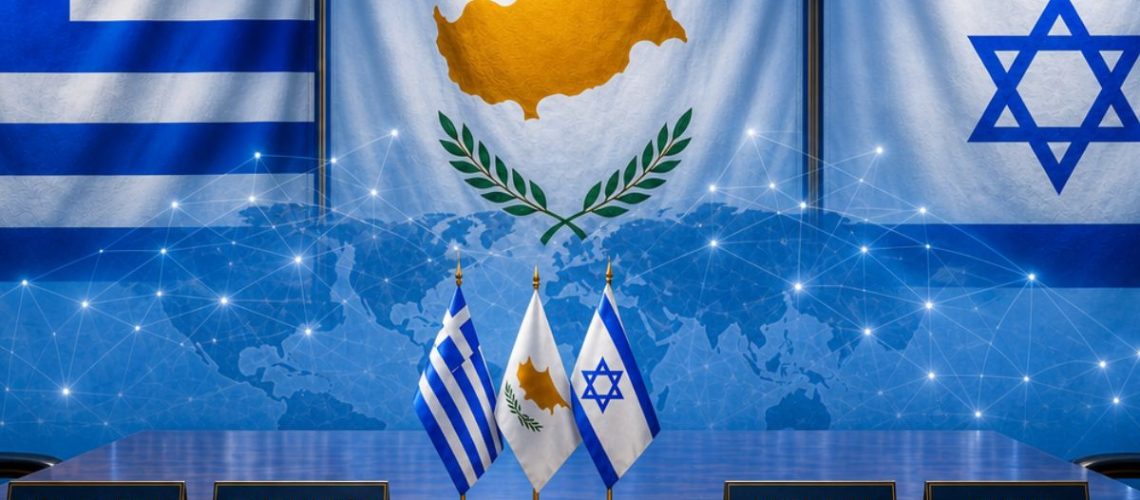

A Strategic Choice, Not a Temporary Alignment
Greece and Cyprus have reached maturity. Their relationship with Israel cannot depend on leaders or crises. It should become an alliance of choice: practical, prosperous and open to Arab cooperation. Israel offers strategic depth and value through established business, trade and security ties with Europe and America. Daily, it confronts missiles, drones, terrorism and hostile networks threatening its sovereignty and the Eastern Mediterranean, serving as a regional security provider.
“Greece and Cyprus should stand as Israel’s allies by choice, as their security environments are increasingly being shaped to overlap over the long term.”
Israeli strikes hit Syria’s Abu al-Duhur airbase on 18 August 2026 over an alleged Turkish deployment. Turkey blocked NATO-Israel cooperation and suspended trade. Greece and Cyprus cannot remain distant while Ankara pressures the Eastern Mediterranean, occupies northern Cyprus and expands influence in Syria, Libya and the Red Sea. This concerns Erdogan’s government, not Turkish society.
The Erdogan government stands on the wrong side of history when it attempts to systematically transform past Ottoman conquests into an unlawful modern entitlement, erasing the Byzantine Greek, Jewish and other indigenous histories of these lands. Conquest creates neither indigenous legitimacy nor a veto over neighboring states.
From Strategic Partners to Strategic Allies
The December 2025 Greece-Cyprus-Israel summit reaffirmed cooperation in security, defense, energy, civil protection and connectivity, while the 2026 military plan expanded air and naval exercises. Greece’s Achilles Shield, valued at up to €3.5 billion, places Israeli technology within a €28 billion modernization program through 2036; 25% is expected to be produced in Greece.
Achilles Shield should integrate radars, command networks and interceptors against aircraft, drones, cruise missiles and ballistic threats across Greece’s air, naval and electronic-warfare systems.
Next should come a Trilateral Strategic Alliance Accord. Without copying NATO’s collective-defense clause, it should require consultation when sovereignty, infrastructure or civilian security is threatened. A ministerial council and secretariat should produce annual threat assessments through working groups on air defense, maritime security, cyber threats, intelligence, counterterrorism, emergency response and strategic communications.
Exercises should test ports, airports, energy installations and civil protection. Joint laboratories should develop counter-drone systems, secure communications, artificial intelligence, autonomous platforms and space surveillance. Procurement must include co-production, intellectual property, maintenance and exports. Their engineers should jointly design, repair and improve technologies.
Antisemitism Is a Security Threat
Opposing antisemitism is essential to protecting freedom and democracy. Protecting Jewish people from intimidation protects freedom for everyone. Everyone has the right to criticize the policies of any government, including Israel’s. However, criticism crosses the line when it collectively blames Jewish people, promotes hatred or harassment, or denies Israel’s right to exist. The EU Fundamental Rights Agency reported that 96% of Jewish respondents encountered antisemitism in the year before its 2023 survey; 80% believed it had increased, while 76% sometimes concealed their Jewish identity.
Greece and Cyprus should continue to protect and enhance their Jewish, Greek and Cypriot communities, improve incident reporting, and train police and educators to distinguish legitimate political debate from antisemitic hate speech. Trilateral programs involving universities and think tanks should promote shared historical understanding, Jewish history, Holocaust education, interfaith dialogue, media literacy and greater togetherness.
Combating antisemitism does not silence criticism; it protects the democratic space in which criticism can be expressed without targeting an entire people or faith. These efforts should also include stronger cooperation among civil-society organizations, religious institutions and public authorities, ensuring that Jewish communities have meaningful representation in discussions about security, education and social cohesion.
“By combining principled support for Israel’s security with respect for human rights and accountability, Greece and Cyprus can help advance a balanced regional dialogue grounded in democracy, historical awareness and mutual respect.”
Protect and Expand to the Abraham Accords 2.0
The original Abraham Accords should be protected and expanded into Abraham Accords 2.0. This phase should become a global strategic framework, open to states beyond the Middle East and not restricted by geography. Participation should be based on a commitment to peaceful relations, mutual recognition, security, trade, investment, technological advancement and practical regional connectivity.
The framework should connect Israel, Greece and Cyprus with the existing Abraham Accords countries, the established peace partners of Egypt and Jordan, and—when political conditions permit—Saudi Arabia. It should also welcome willing partners from Europe, Africa, Asia, the Indo-Pacific and the Americas. Greece and Cyprus can provide the institutional bridge to the European Union, while Israel and the Arab states contribute strategic reach, investment capacity, technological expertise and regional knowledge.
Abraham Accords 2.0 should collectively address terrorism, missile and drone threats, cyberattacks, maritime insecurity, attacks against critical infrastructure, economic coercion and organized disinformation. Its purpose should not be confrontation for its own sake, but the protection of states and societies that choose genuine strategic cooperation over instability, ideological hostility and geopolitical revisionism.
Governments, movements and non-state actors that reject peaceful coexistence or attempt to undermine the Israel–Greece–Cyprus relationship must not be permitted to determine its direction. The countries that invest in peace, security and shared prosperity should shape the new strategic architecture.
The platform must also create economic depth. EU-Israel goods trade reached €43.3 billion in 2025; Greek exports to Israel were approximately $1.13 billion, while Cyprus exported about $291 million and imported nearly $494 million. A Trilateral Investment and Trade Council should set targets for foreign direct investment, joint ventures, patents, employment and exports across defense, cybersecurity, energy, shipping, ports, finance, technology, water, agriculture, health, tourism and education.
IMEC, the Great Sea Interconnector and a future Israel-Cyprus electricity link can connect ports, grids, digital cables and investment. Every summit should publish delivery dates, responsible institutions and financing sources, turning declarations into strategic depth.
Somaliland: Recognition as Strategic Initiative
Israel’s recognition of Somaliland on 26 December 2025 was proactive. Somaliland has governed itself since 1991 beside the Gulf of Aden route toward Bab el-Mandeb. Its president pledged to join the Abraham Accords, with cooperation proposed in agriculture, health, technology and trade. The African Union and Somalia opposed recognition; their objections require engagement, but should not grant Ankara a veto over Greek-Cypriot policy.
Greece and Cyprus should coordinate recognition based on legal review, democratic benchmarks, border commitments and guarantees against forced population transfers or destabilizing military use. They should open liaison offices, negotiate maritime-security and commercial agreements, support education, and invite Somaliland into selected Abraham Accords working groups. Formal recognition should follow through synchronized decisions.
Somaliland must be distinguished from occupied Cyprus. Former British Somaliland became independent in June 1960 before entering a voluntary union. The Turkish-controlled north resulted from foreign military intervention, occupation and demographic alteration, and remains recognized only by Turkey. The circumstances differ. Cyprus should explain this distinction so recognition strengthens its principled opposition to secession created by external force.
The Decisions That Must Follow
Within twelve months, Greece, Cyprus and Israel should establish the strategic council, sign an investment roadmap, launch innovation calls, expand civil-protection exercises and convene an Abraham Accords 2.0 forum with Arab, European and Somaliland participation. Parliamentary, university and business tracks should sustain cooperation through change.
“Greece and Cyprus need not choose between Israel and the Arab world. Strategy means standing with Israel, deepening Arab partnerships, resisting Turkish revisionism, combating antisemitism and connecting the Eastern Mediterranean with the Gulf and Red Sea. The time has come to move from partnership to alliance – with responsibility, interests and courage to shape events.”
REFERENCES
[1] Cornwell, Alexander, and Tuvan Gumrukcu. ‘Israel and Turkey Step Up Warnings over Syria after Airbase Bombing.’ Reuters, August 20, 2026. https://www.reuters.com/world/middle-east/syria-says-no-turkish-military-build-up-planned-airbase-struck-by-israel-2026-08-20/.
[2] Reuters. ‘Turkey Blocks NATO-Israel Cooperation over Gaza War, Sources Say.’ August 1, 2024. https://www.reuters.com/world/middle-east/turkey-blocks-nato-israel-cooperation-over-gaza-war-sources-say-2024-08-01/.
[3] Government of Israel. ‘Joint Declaration – The 10th Trilateral Summit of Israel, Greece, and Cyprus.’ December 23, 2025. https://www.gov.il/en/pages/spoke-jointdeclaration231225.
[4] European Union Agency for Fundamental Rights. Jewish People’s Experiences and Perceptions of Antisemitism. Luxembourg: Publications Office of the European Union, 2024. https://fra.europa.eu/en/publication/2024/experiences-and-perceptions-antisemitism-third-survey.
[5] United States Department of State. ‘The Abraham Accords Declaration.’ Accessed August 23, 2026. https://www.state.gov/the-abraham-accords.
[6] Reuters. ‘Israel Becomes First Country to Formally Recognise Somaliland as Independent State.’ December 26, 2025. https://www.reuters.com/world/middle-east/israel-recognises-somaliland-somalias-breakway-region-independent-state-2025-12-26/.
[7] European Commission. ‘EU Trade Relations with Israel.’ Accessed August 23, 2026. https://policy.trade.ec.europa.eu/eu-trade-relationships-country-and-region/countries-and-regions/israel_en.
[8] Reuters. ‘Greece to Buy $4 Billion Air Defence System from Israel.’ July 23, 2026. https://www.reuters.com/business/aerospace-defense/greece-buy-35-billion-air-defence-system-israel-sources-say-2026-07-23/.
[9] Reuters. ‘Greece, Israel and Cyprus to Step Up Joint Exercises in Eastern Mediterranean.’ December 29, 2025. https://www.reuters.com/business/aerospace-defense/greece-israel-cyprus-step-up-joint-exercises-eastern-mediterranean-2025-12-29/.
[10] Associated Press. ‘Cyprus and Israel Seek to Quickly Establish an Electricity Linkup via an Undersea Cable.’ May 5, 2025. https://apnews.com/article/e0fac3a0c5d53824266016b4ae17bcfa.
[11] Efthymiopoulos, Marios P. ‘Why Greece Is Betting Billions on Israeli Air Defense—and How It’s Shaping the Eastern Mediterranean.’ Mideast Journal (Middle East 24), July 30, 2026. https://www.mideastjournal.org/post/greece-israel-defense-partnership-achilles-shield.

