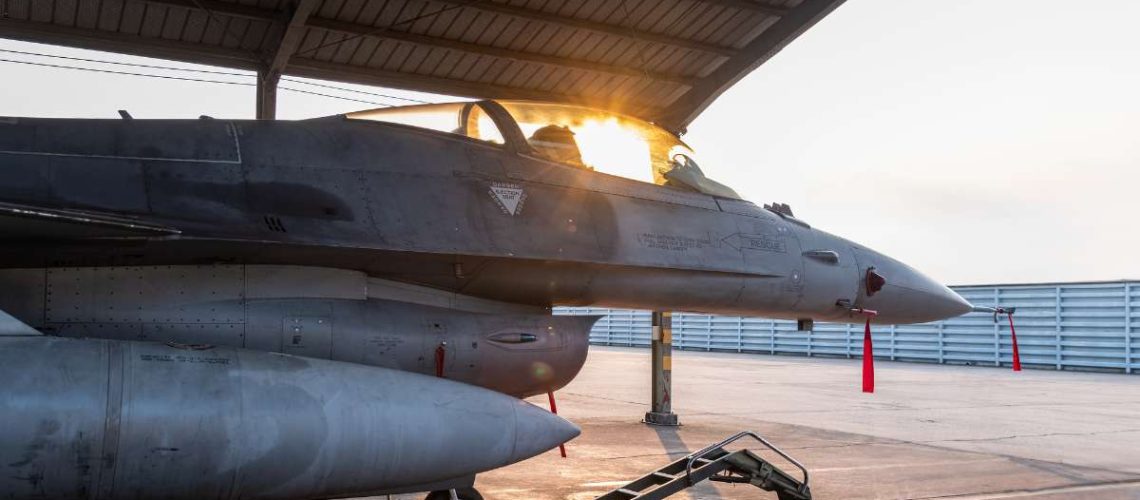

Recent reporting in Cyprus press [1] suggesting that the country seeks a more permanent presence of Hellenic Air Force fighters on the island has reopened an important strategic discussion. Following growing concerns regarding regional instability and airspace security, policymakers in Nicosia appear increasingly interested in moving beyond occasional deployments toward a more stable framework of defense cooperation with Greece. The real question, however, is whether such deployments can become the foundation of a sustainable Cypriot airpower capability.
“The strategic challenge for Cyprus is not acquiring the perfect fighter. It is building a credible airpower ecosystem.”
For more than five decades, the Republic of Cyprus has operated without a combat fixed-wing aviation arm. While the National Guard has developed significant capabilities in other domains, air defense remains dependent on ground-based systems, allied cooperation, and periodic support from Greece.
The current discussions regarding a more permanent Hellenic Air Force presence, therefore, present an opportunity extending far beyond air policing. A phased approach could transform rotational deployments into long-term capability development, gradually building operational expertise, interoperability, and institutional knowledge between the Cypriot National Guard and the Hellenic Air Force. Such cooperation would generate institutional knowledge that currently does not exist on the island.
Now, Greece plans to gradually retire its F-4E AUP Phantom fleet in the context of the F-35 5th generation fighter acquisition. Part of these modernised Phantom aircraft inventory could potentially be transferred to Cyprus while the remaining airframes (a huge number, including the -already withdrawn- SRA/RF versions) would be retained as a strategic reserve of spare parts, support equipment, and maintenance assets. Such an arrangement would differ fundamentally from a conventional fighter acquisition program. Instead of purchasing an expensive new platform and subsequently struggling to sustain it, Cyprus would inherit an ecosystem built upon decades of operational experience and minimal risk.
The principal advantage of such a solution is not performance but economics. Virtually every alternative fighter acquisition currently available to small states requires expenditures measured in billions of euros. Procurement is only one component of the overall cost, which also includes infrastructure, training, logistics, and long-term sustainment. A Phantom transition force would be fundamentally different. The aircraft, training expertise, maintenance know-how, and much of the logistical framework already exist.
Cyprus would not simply acquire aircraft but an entire sustainment ecosystem. For example, seven or eight aircraft could remain operational while the remaining airframes could serve as a strategic reserve of components, structures, engines, avionics, and spare parts. Small air forces rarely fail because they cannot acquire aircraft, but because they cannot sustain them. A fleet accompanied by a substantial reserve of donor airframes fundamentally alters that equation.
The geography of Cyprus further strengthens this argument. The maximum distance across the island is approximately 200 kilometers. The time required for an aircraft to cover a given distance is governed by:
t = s / V,
where t is time, s is distance, and V is velocity.
For an aircraft travelling at approximately 900 km/h:
t = 200 / 900
t ≈ 0.22 hours,
or approximately thirteen minutes.
The geography of Cyprus favors rapid response and sustained presence over long-range maneuver warfare.
T = Fuel / Fuel Flow
The Phantom was designed as a long-range twin-engine combat aircraft capable of carrying substantial internal fuel reserves and external stores. This characteristic remains valuable in the Eastern Mediterranean.
Operational effectiveness is therefore better measured by station time:
Tstation = Ttotal − Ttransit
For Cyprus, where aircraft may initially operate from Greek territory, or will be used for extended maritime surveilance missions from the island, time spent over the operational area may be more important than absolute performance figures. The Phantom’s fuel capacity contributes directly to this requirement.
Combat effectiveness is also influenced by payload capacity.
L = ½ρV²SCL
L is lift, ρ is air density, V is airspeed, S is wing area, and CL is the coefficient of lift.
The Phantom’s wing area of approximately 49.2 square meters is significantly larger than the 27.8 square meters of the F-16. While this does not make it a superior fighter, it reflects a design philosophy emphasizing payload and range rather than agility. For a transitional force focused on deterrence, maritime surveillance, and air policing, these characteristics remain operationally relevant.
Geography imposes another requirement often overlooked in public discussions. Cyprus does not operate over a continental battlespace, but over one of the largest maritime areas in Europe. The Eastern Mediterranean imposes different operational demands than those encountered over mainland Europe. Long overwater flights place a premium on reliability and survivability in the event of mechanical failure. In this context, the Phantom’s twin-engine configuration deserves consideration. The availability of a second powerplant remains a relevant operational advantage when flying extended missions over open water hundreds of kilometers from the nearest suitable airfield. For missions conducted across the vast maritime spaces of the Eastern Mediterranean, this characteristic remains operationally relevant. Furthermore the aircraft’s two-crew configuration can support a ‘missionised’ philosophy, with the co-pilot utilising high-tech solutions and easing the workload of the commander.
Yet focusing exclusively on aircraft performance risks overlooking the broader strategic opportunity. The true value of such a program may lie in the technological ecosystem it could create.
“The most important legacy of a Cypriot Phantom force may not be the aircraft themselves, but the national capabilities developed around them.”
Artificial intelligence is rapidly transforming military operations. For smaller states, however, the most valuable applications are often not autonomous weapons but practical tools that improve readiness, reduce costs, and enhance decision-making. A Cypriot-Greek Phantom initiative could become a testbed for Cyprus sovereign defense AI solutions developed by local universities, research centers, startups, and technology firms. The purpose would not be to modify the aircraft themselves. Rather, AI would operate around the platform as a force multiplier.
Predictive maintenance tools could assist technicians in identifying failures, forecasting spare-part requirements, and prioritizing maintenance resources across a fleet supported by donor airframes. AI-assisted mission-planning systems could optimize sortie scheduling, fuel planning, aircraft allocation, and operational readiness. Machine-learning applications could fuse information from coastal radars, air-defense systems, maritime surveillance assets, drones, and intelligence feeds into a common operational picture. Such technologies would also support maritime domain awareness and critical infrastructure protection, retaining value long after the Phantom fleet itself is retired.
Strategic capability depends as much on institutions, logistics, training, and technology as on platforms themselves. The current discussion regarding a more permanent Hellenic Air Force presence in Cyprus should therefore be viewed not merely as a question of aircraft deployment, but, mainly, as an opportunity to build the foundations of a long-term Cypriot airpower ecosystem. Ultimately, the platform matters less than establishing the institutional and technological framework capable of sustaining it. The strategic objective should be the gradual development of a sustainable, sovereign, and technologically sophisticated national capability rather than permanent dependence.
In that context, a phased Phantom transition, supported by Greek cooperation, strategic transfer of retiring assets, an unprecedented spare-parts reserve, and indigenous AI-enabled support systems, may offer Cyprus a unique opportunity to move from symbolic presence to genuine capability.
REFERENCES
[1] Poyiadji A., ‘Μόνιμα στην Πάφο τα ελληνικά μαχητικά’, Fileleftheros newspaper website, https://www.philenews.com/kipros/koinonia/article/1732914/monimopiounte-ta-ellinika-machitika-stin-pafo-pithani-allagi-ston-tipo-ton-aeroskafon-sinechizi-na-plei-stin-kipriaki-aoz-to-elliniko-naftiko/
[2] Hellenic Air Force technical information regarding the F-4, https://www.haf.gr/arsenal/f-4e-phantom-ii/
