

Beyond Technology? Why Digital Innovation Does Not Always Deliver Growth: A Policy Brief
Digital transformation has become a central pillar of economic development strategies worldwide. Governments and international organizations increasingly invest in broadband networks, digital services, and innovation ecosystems, expecting technological progress to accelerate productivity, competitiveness, and long-term growth. Yet the relationship between digital innovation and economic performance remains more complex than often assumed, particularly in developing economies.
Recent research combining panel econometric analysis and machine learning techniques reveals that digital development does not generate uniform outcomes across countries. Rather, significant heterogeneity exists, reflecting differences in institutional capacity, economic structure, human capital, and digital readiness. While digital infrastructure is generally associated with improved economic performance, the impact of digital innovation, as measured by the ICT index, appears to depend heavily on the broader environment in which it is deployed.
One of the study’s most important findings is that innovation-related digital indicators do not automatically translate into higher economic growth. In several developing economies, digital services and technological capabilities expand faster than they integrate productively into the economy. Country-specific estimations revealed considerable heterogeneity in the innovation-growth relationship. While several economies showed positive and statistically significant innovation effects, only Pakistan retained a positive and statistically significant coefficient under the full country specification, which included multiple structural controls. These findings suggest that the growth benefits of digitalization depend on country-specific enabling conditions, including infrastructure, institutions, and broader economic characteristics.
As a result, innovation investment without sufficient complementary infrastructure such as reliable infrastructure, effective governance, skills development, and business adoption, may fail to generate economic returns.
A subgroup analysis based on broadband penetration revealed substantial differences between high- and low-broadband economies. In countries with relatively advanced broadband infrastructure, innovation exhibited no statistically significant relationship with economic growth. In contrast, innovation was negatively and significantly associated with growth in low-broadband economies (β = -0.357, p < 0.001). The results indicate that the economic benefits of digitalization are less likely to emerge where broadband networks remain underdeveloped, highlighting the importance of infrastructure readiness in converting digital capabilities into economic performance.
In low-broadband countries, there is a significant negative ICT-growth relationship.

In high-broadband countries, the negative innovation effect is eliminated:

The negative ICT-growth relationship is concentrated in countries with weaker broadband ecosystems. Broadband infrastructure is a critical enabling condition that shapes whether innovation development can be translated into economic growth.
“The economic effects of digital innovation are highly heterogeneous across developing economies.“
Machine-learning results further reinforce this conclusion. Fixed broadband infrastructure emerged as the most important predictor of economic growth in the Random Forest analysis, exceeding the relative importance of innovation development, government effectiveness, FDI, and mobile broadband indicators.
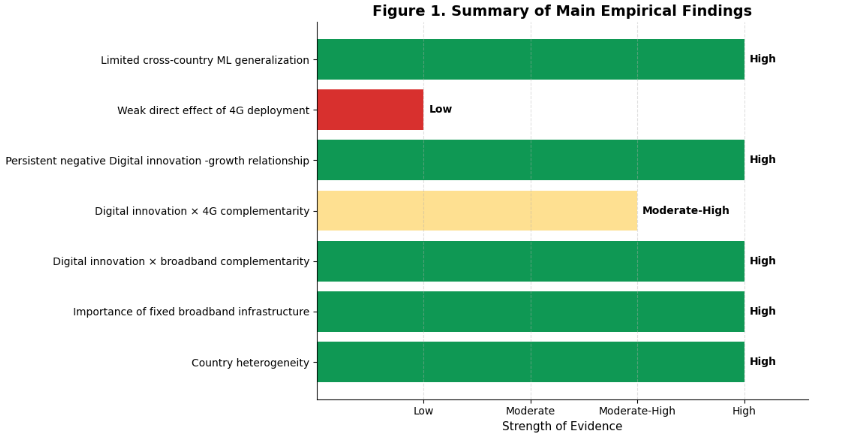
From a methodological perspective, the research employed both traditional econometric models and machine learning classification techniques. While machine learning methods successfully identified country patterns and structural differences, their predictive performance varied across contexts. This finding demonstrates that economic development remains influenced by country-specific characteristics that cannot always be captured through universal predictive models. The result reinforces the importance of tailoring policy interventions to national circumstances rather than relying on one-size-fits-all development strategies.
Practical implications
The findings provide several important lessons for policymakers, development organizations, and business leaders.
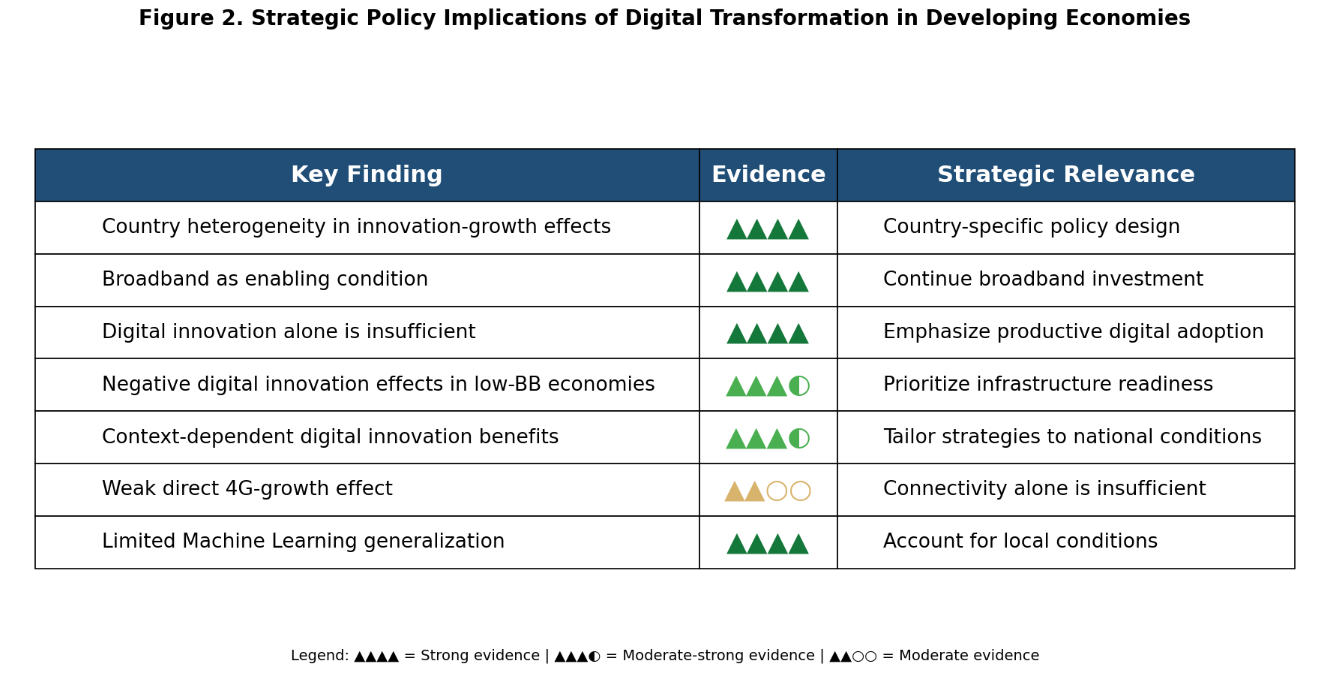
First, digital policy should move beyond simple connectivity and technology deployment targets. While expanding access to digital technologies remains important, the results suggest that technology adoption alone does not consistently generate economic growth. Policymakers should focus on creating the conditions that enable digital technologies to be integrated into productive economic activities.
Second, broadband infrastructure emerges as a critical enabler of digital transformation. The subgroup analysis revealed that the negative innovation-growth relationship was concentrated in economies with relatively low levels of broadband development, whereas no significant relationship was observed in countries with stronger broadband infrastructure. This finding suggests that investments in digital innovation should be paired with continued investment in high-capacity broadband networks that support the effective diffusion and use of digital technologies.
“Broadband infrastructure is a critical enabling condition for translating digital capabilities into economic growth.“
Third, digital investments should be complemented by measures that strengthen institutional quality, digital skills, and innovation capacity. The economic value of digital technologies depends not only on access but also on firms’, workers’, and public institutions’ ability to use digital tools productively and on scale.
Fourth, policymakers should recognize that developing economies follow distinct digital development trajectories. Country-level evidence revealed substantial heterogeneity in ICT-growth relationships, indicating that policy approaches successful in one economy may not generate comparable outcomes elsewhere. Digital strategies should therefore be tailored to national circumstances, infrastructure readiness, and institutional capabilities.
More broadly, the findings suggest that the benefits of digital transformation arise not from technology deployment in isolation but from how technology interacts with complementary economic and institutional factors. Digital innovation appears most effective when supported by adequate broadband infrastructure, effective governance, and an ecosystem that facilitates knowledge diffusion, entrepreneurship, and technological adoption.
For governments and development agencies, the central message is clear: sustainable digital growth requires a holistic approach that integrates infrastructure, innovation, governance, and human capital into a coherent development strategy. Investments focused solely on digital technologies are unlikely to deliver their full economic potential unless accompanied by the complementary conditions that enable digital transformation to generate productive and inclusive growth.
In conclusion, the principal finding of this research is that digital innovation is not less important, but that its economic impact depends on context. Across 41 developing economies, innovation development alone did not generate consistent growth outcomes. Instead, the evidence indicates that digital technologies are most likely to contribute to growth when supported by complementary infrastructure and enabling institutional conditions. Broadband infrastructure, in particular, emerged as a critical factor shaping digital-development outcomes. These findings suggest that successful digital transformation strategies should prioritize ecosystem development, combining innovation, connectivity, governance, and human capital rather than focusing on technology deployment in isolation.
References
- Aravantinos, E., & Varoutas, D. (2025). Clustering emerging economies by broadband diffusion trajectories. In ITS 33rd European Conference 2025: Digital innovation and transformation in uncertain times (Edinburgh, UK, June 29-July 1, 2025). International Telecommunications Society (ITS). https://hdl.handle.net/10419/331250
- Aravantinos Elias and Dimitris Katsianis “Country Heterogeneity, Digital Innovation, and Economic Growth: Evidence from Panel Econometrics and Machine Learning in Developing Economies” working paper
- Goldfarb, A., & Tucker, C. (2019). Digital Economics. Journal of Economic Literature, 57(1), 3-43.
- Ho, T. L., & Ho, T. H. (2025). Digital inclusion or exclusion? Exploring the moderating role of governance in digitalization’s impact on income inequality in developing countries. Research in Globalization, 9, 100283. https://doi.org/10.1016/j.resglo.2025.100283
- Hjort, J., & Tian, L. (2025). The economic impact of internet connectivity in developing countries. Annual Review of Economics, 17, 489–518. https://doi.org/10.1146/annurev-economics-081224-102352

