
Western commentators are yet again proclaiming that the Ukraine war has reached a turning point and that Kyiv’s victory is just around the corner. We heard this after the Kharkiv offensive in 2022. We heard it before the failed 2023 counteroffensive. And we heard it after the Ukrainian incursion into Kursk. Each time the “turning point” turned out to be little more than wishful thinking, while Russia continued its slow but steady movement west.
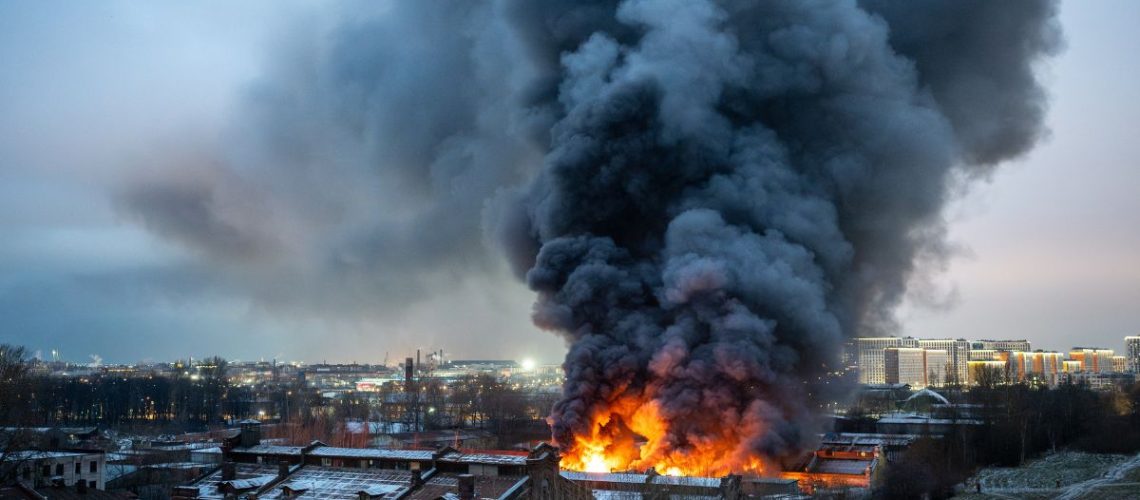
The occasion this time was precipitated by Kyiv’s successful attacks on Russian territory, damaging Russian energy resources and infrastructure. These attacks were impressive. On the night of September 2, the mayor of Moscow reported 548 Ukrainian drones flying toward the capital.[1] Vnukovo airport suspended operations; Sheremetyevo and Domodedovo restricted flights. A day earlier, President Zelensky had warned that Russian airspace was “de facto closed,” and Kyiv followed with a formal notice to the International Civil Aviation Organization.[2] Most recently, the Governor of the Krasnodar region declared a state of emergency due to drone attacks.[3] This is a remarkable achievement. Nonetheless, it is worth asking what these strikes accomplish. While they have caused immediate pain in Russia, unfortunately, when one looks at the larger picture, the answer is not much.
Based on data from Ukraine’s DeepState group, Russia now holds about 19% of Ukraine, and over the past year it has added roughly 886 square miles.[4] While there have been some setbacks in Russia’s advance north of Lyman [5] and the pace is slower than a year ago, coming at an enormous cost in Russian lives,[6] the advance is real. Pokrovsk and Myrnohrad fell over the winter. As this piece is being written, Russian forces are grinding toward Kostyantynivka and the remaining fortress cities in the Donetsk region. Furthermore, Russia has basically turned Ukraine into a landlocked state by effectively closing access to Odessa’s port complex, through attacks on port facilities and approaching ships.[7]
Similarly, Russia continues to outpace Ukraine in manpower. By some estimates, Moscow is able to sign up roughly 30,000 contract soldiers a month, enough to replace its losses, while Ukraine has been recruiting somewhere between 17,000 and 24,000, with some brigades operating at a fraction of their authorized strength.[8] According to Kyrylo Budanov, head of the Presidential Office, Ukraine must mobilize at least 30,000 men every month simply to hold its current positions. Despite its controversial campaign of grabbing conscription age men off the street, it is not meeting this target, and Ukrainian prosecutors have opened more than 310,000 criminal cases for desertion and unauthorized absence since the war began.[9]
Divisions over the war are growing and the strain is now visible at the top. The dismissal of Defense Minister Mykhailo Fedorov in July resulted in protests in Kyiv. Fedorov has broken with Zelensky, declaring that Ukraine is “gradually, slowly losing” and calling for wartime elections. Zelensky’s former press secretary Iuliia Mendel accused the president of committing “national suicide”.[10] At the same time, anti-corruption authorities have brought charges against a slew of government officials including a deputy head of the presidential administration.[11] To make matters worse, recently, President Zelensky announced a massive $27 billion defense budget shortfall, described as Ukraine’s “worst budget situation” since the war began.[12]
“The theory behind deep strikes is that they raise the cost of war for your opponent, forcing the leadership to recalculate. But a country cannot sustain an escalating war on its enemy’s territory while its own government is losing the confidence of its people, its army is running short of soldiers, and its economy is in shambles. Furthermore, this strategy assumes the Kremlin sees the war as a policy choice that can be reversed. “
But it does not and it never has. In 2008, William Burns, then the American ambassador in Moscow and later Director of the CIA, noted that Ukrainian membership in NATO was “the brightest of all redlines” for the entire Russian political class, not just Putin, and warned that pressing the issue could split Ukraine and draw Russia in.[13] Russia has always viewed a NATO-aligned Ukraine as an existential threat. It now sees this war as a proxy conflict with the West. In short, it cannot afford to lose this war.
This is why the strikes are far more likely to harden Moscow’s resolve than to soften it. A state that believes it is fighting for its survival does not respond to pain by conceding. The pattern is obvious: every Ukrainian success has led to more escalation, not retreat. The BBC has reported that Kyiv is now suffering more daily attacks than at any point since the war began.[14] More importantly, each round of Ukrainian escalation gives Russian hardliners one more argument that a functional Ukraine will always be a platform for attacks on Russia.[15] The logic of the war is drifting from securing the four oblasts it now claims, toward ensuring Ukraine will never be able to strike Russian territory or be used, by an outside power, for such a threat.
None of this is an argument that Ukraine is wrong to defend itself, nor does it relieve Russia of responsibility for its actions. It is an argument about where the current trajectory leads.
“A war that Russia has defined as existential cannot be ended by making Russians uncomfortable. It can only end at the negotiating table, and the longer both sides wait to sit at one, the worse the terms will be for the side that is slowly losing ground. This will require the United States, Europe, and Kyiv to accept that an imperfect settlement now is preferable to a far worse one later. History offers little comfort to those who wait for a better deal while losing ground. This war must end before it gets worse.”
References
1 “How Much Can Ukraine Disrupt Civilian Flights in Russia?” RFE/RL, republished by GlobalSecurity.org, September 3, 2026, https://www.globalsecurity.org/wmd/library/news/ukraine/2026/09/ukraine-260903-rferl02.htm.
2 “‘Russian Airspace Will Effectively Be Closing’: Zelenskyy Warns Airlines Russian Skies Are No Longer Safe,” Euromaidan Press, September 1, 2026, https://euromaidanpress.com/2026/09/01/zelenskyy-warns-airlines-russian-skies-are-no-longer-safe/; on the ICAO notification, see note 1 above.
3 “Russia’s Krasnodar region declares state of emergency as drone attacks slow grain exports,” Reuters, September 24, 2026, https://www.yahoo.com/news/articles/russias-krasnodar-region-declares-state-121937462.html
4 “The Russia-Ukraine War Report Card, September 9, 2026,” Russia Matters, September 9, 2026, https://www.russiamatters.org/news/russia-ukraine-war-report-card/russia-ukraine-war-report-card-sept-9-2026.
5 Roman Pataj, “We Lied to Ourselves Again, Russians Write, as Ukrainians Reportedly Advance Beyond the Zherebets River (Ukraine Battlefield Update, Day 1,665),” EUobserver, September 16, 2026, https://euobserver.com/237930/we-lied-to-ourselves-again-russians-write-as-ukrainians-reportedly-advance-beyond-the-zherebets-river-ukraine-battlefield-update-day-1665/.
6 Institute for the Study of War and Critical Threats Project, “Russian Offensive Campaign Assessment, September 1, 2026,” Critical Threats, September 1, 2026, https://www.criticalthreats.org/analysis/russian-offensive-campaign-assessment-september-1-2026.
7 George Beebe, “Russia’s Lockdown of Odessa Ports Could Be a Grim Turning Point in War,” Responsible Statecraft, August 11, 2026, https://responsiblestatecraft.org/odessa-ports-ukraine-russia/
8 Swedish Centre for Eastern European Studies, “The Ukrainian Mobilization Challenge: Military and Society during Full-Scale War,” December 19, 2025, https://sceeus.se/en/publications/the-ukrainian-mobilization-challenge-military-and-society-during-full-scale-war/; on Russian recruitment, see “Should Russia Brace for a New Mobilization?” Moscow Times, July 21, 2026, https://www.themoscowtimes.com/2026/07/21/should-russia-brace-for-a-new-mobilization-a93256
9 “Ukraine Must Mobilize at Least 30,000 People per Month, Budanov Says, Warns War Won’t End Soon,” Kyiv Independent, August 28, 2026, https://kyivindependent.com/budanov-says-ukraine-must-mobilize-at-least-30-000-people-per-month-warns-that-war-wont-end-soon/; on desertion cases, see “Russia Has a Desertion Problem. Ukraine Has a Manpower Crisis,” bne IntelliNews, July 12, 2026, https://www.intellinews.com/russia-has-a-desertion-problem-ukraine-has-a-manpower-crisis-454088/.
10 Iuliia Mendel, “Zelensky’s Strategy is National Suicide” The Spectator, September 15, 2026, https://spectator.com/article/zelenskys-strategy-is-national-suicide/?edition=us
11 “As a Former Defense Minister Revolts in Ukraine, Is Zelensky’s System Fracturing?” Carnegie Endowment for International Peace, August 2026, https://carnegieendowment.org/russia-eurasia/politika/2026/08/ukraine-politics-president-trouble
12 Jeanna Smialek and Siobhán O’Grady, “Ukraine Says It Needs $27 Billion More. Europe Wants to Know Why.” New York Times, Sept. 9, 2026, https://www.nytimes.com/2026/09/09/world/europe/ukraine-war-cost.html.
13 William J. Burns, “Nyet Means Nyet: Russia’s NATO Enlargement Redlines,” cable 08MOSCOW265, U.S. Embassy Moscow to Secretary of State, February 1, 2008, published by WikiLeaks, https://wikileaks.org/plusd/cables/08MOSCOW265_a.html.
14 James Landale and Christine Jeavans, “Kyiv Air Raid Alerts at Record High as Russia Launches Round-the-Clock Strikes,” BBC News, September 7, 2026, https://www.bbc.com/news/articles/cjdvx9pz44ro.
15 Andrew Osborne, “Russian Hawks Urge Putin to Escalate War, Drop US Talks as Ukraine Strikes Deep,” Reuters, June 26, 2026, https://www.reuters.com/world/europe/russian-hawks-urge-putin-escalate-war-drop-us-talks-ukraine-strikes-deep-2026-06-26/.

