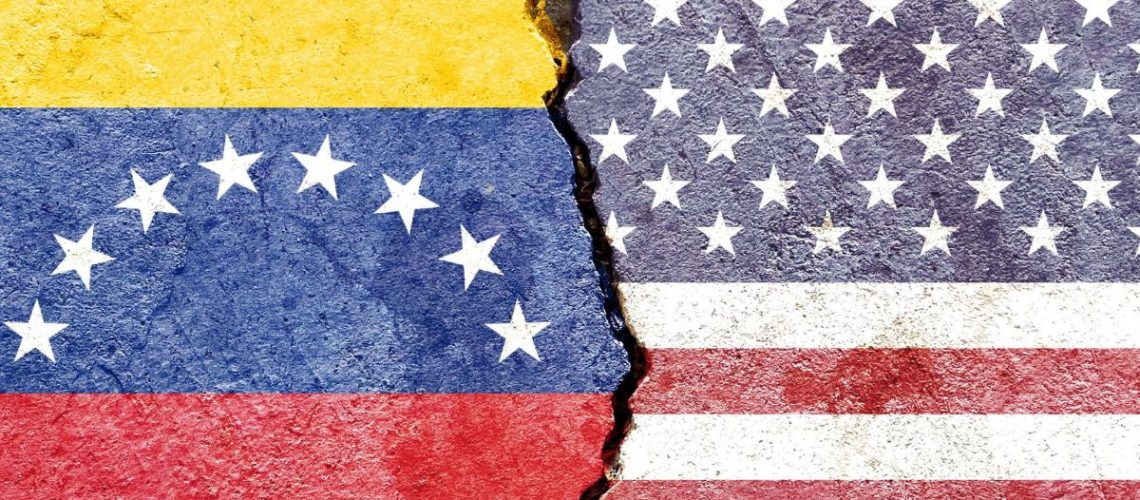

The operation carried out in the early hours of January 3 in Venezuela by U.S. armed forces, resulting in the extraction of Nicolás Maduro in a manner similar to the operation that killed Osama bin Laden, marks another step in the unprecedented U.S. interventions in Latin America under Donald Trump. This action follows a series of robust moves in the region: sanctions against Colombia after its president criticized Washington; strong support for a presidential candidate in Honduras, which included the pardon of a former president convicted in the U.S. of drug trafficking (ironically, the same charge now used, at least on paper, to justify Maduro’s detention); and robust economic backing for Javier Milei’s administration in Argentina, among other actions.
Despite the successful detention of Maduro, the Chavist regime itself remains in place, against the expectations of millions of Venezuelans. There were no large-scale protests following the detention, nor any attempts to take over the presidential palace. None of that has happened, but certainly, the removal of Maduro has left the regime at its most fragile point since it came to power.
Across the world, doubts persist about the legality of the operation. However, it was likely the only viable way to remove Maduro. Now, the central issue in Venezuela is whether the government will hold. Trump sidelined María Corina Machado, the Venezuelan who won the Nobel Peace Prize, and instead reaffirmed the authority of Delcy Rodríguez, Maduro’s second-in-command, as “acting president.” Meanwhile, arrests and repression continue inside Venezuela.
The Cuban influence
Cuba reported that more than 30 Cubans died during the operation that extracted Maduro[1]. This provides undeniable evidence that Cuban personnel were part of Maduro’s inner security team, reinforcing the idea that Maduro was, in effect, a man who answered to Cuba. It also explains why Maduro was unlikely ever to surrender to the United States or go into exile: Havana would never have authorized it.
U.S. pressure on Venezuela appears aimed less at immediate regime change and more at reshaping the regional balance of power. One of the countries most affected by a weakened or transformed Venezuela would be Cuba, as it is losing access to subsidized oil and other key sources of income. This comes at a critical moment for Havana, which is already facing a severe economic crisis and has recently loosened currency controls to improve its finances. However, it is complicated for the Cuban revolution to collapse. The problem is succession, as there is no clear alternative. Cuban society has been controlled, repressed, and infiltrated by intelligence services for decades, making the construction of a viable opposition extremely difficult. In many ways, this is precisely the model that Cuba attempted to replicate in Venezuela, and it probably explains why those who oppose the government remain cautious in Venezuela.
Even in the event of regime change in Venezuela, the situation would be dangerous for the country. Ecuador offers a cautionary tale, as after years of strong state intervention, it has become a country engulfed in violence, with record levels of assassinations. Bolivia, after the years of Evo Morales, also became more violent and increasingly dominated by drug trafficking. Venezuela could face a similar path.
From an economic perspective, the short-term outlook for Venezuela is bleak. Conditions are likely to worsen. A long-term question is whether there will be genuine economic change or whether the Chavista system will begin implementing reforms, driven less by U.S. pressure and more by economic reality. This could be one of the paths available to Delcy Rodríguez, assuming the regime—and perhaps Cuba—allows it.
The most obvious area for recovery would be oil production. Venezuela holds the world’s largest proven oil reserves—nearly 20%—yet produces only 1% to 2% of global supply. U.S. oil companies could emerge as the main beneficiaries if the U.S. “runs Venezuela”. This explains why their stocks rose sharply on Monday [2].
Donroe doctrine in action
What is clear is that the United States is doubling down on its role in Latin America, playing its strongest hand in decades. This reflects a new doctrine—one that no longer emphasizes democracy in the region. Neither Secretary of State, Marco Rubio, nor Trump speaks confidently of democracy or elections in Venezuela; instead, they call on Delcy Rodríguez, the “acting president,” to “do the right thing.”
For decades, U.S. policy in Latin America focused on promoting democracy and free trade. This represents a sharp departure. The Trump administration speaks more about tariffs and oil than of free elections. However, a risk for Trump is that if the administration does not achieve regime change in Venezuela, he could face political consequences at home. Conversely, if he succeeds, it could boost his political capital.
The actions of the U.S., combined with Trump’s rhetoric about controlling Venezuela and reclaiming Venezuela’s oil, would likely be labeled “imperialist” if carried out by any other world leader. Could other countries imitate this approach? What happens if China applies a similar doctrine to Taiwan?
The economic impact of the recent actions has so far been limited. Venezuela is not a major economic player, and most of its strategic resources remain underground, with extraction capacity severely constrained. In addition, oil prices are at their lowest level since 2021, further reducing any immediate global impact.
The determination of the United States to push boundaries and undertake hard, high‑risk actions increases global uncertainty and ratifies that the world is entering a new era—one in which Trump openly reclaims the Western Hemisphere as America’s backyard, reviving a modernized version of the Monroe Doctrine (now Donroe), as outlined in the latest National Security Strategy document [3].
References:
[1]https://cnnespanol.cnn.com/2026/01/05/venezuela/32-cubanos-muertos-captura-maduro-orix
[2]https://www.ft.com/content/e4d84f5f-0e7c-423d-8026-33f78331f06e
[3]https://www.whitehouse.gov/wp-content/uploads/2025/12/2025-National-Security-Strategy.pdf
