

Between 2011 and 2022, China experienced rapid digital transformation, institutional strengthening, and a gradual reduction in income inequality. Using SHAP values (SHapley Additive exPlanations, is a method used to interpret and explain the output of machine learning models by quantifying each feature’s contribution to the prediction) derived from 3 predictive models, Extreme Gradient Boosting (XGBoost), Light Gradient Boosting Machine (LightGBM), Categorical Boosting (CatBoost), we analyzed the contribution of six key features to economic growth outcomes with data collected mainly form World Bank: Internet Communication Technology index, ICT index, an annual frontier technology readiness index developed by UNCTAD, 4G deployment × FDI (Foreign Direct Investment), unemployment × inflation, government effectiveness, broadband adoption, and income inequality. This is part of a larger study on developing and emerging economies.
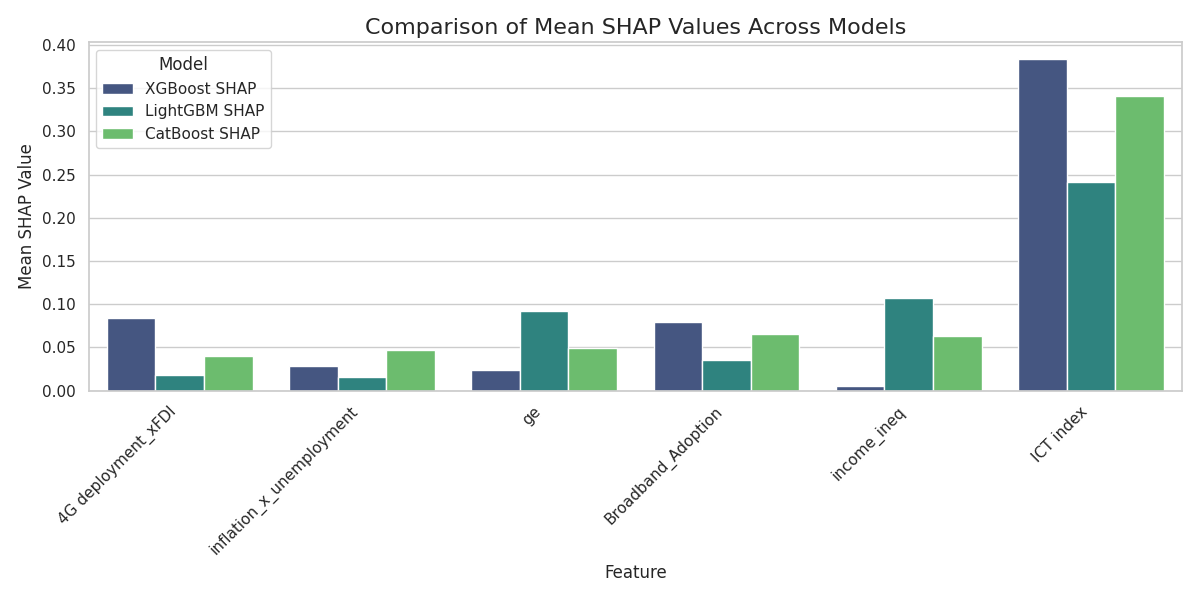
Figure 1: Models’ comparison of mean SHAP values
Based on Figure 1, ICT index towers above the rest, clearly the most influential feature across all models. LightGBM gives more weight to income inequality and governance effectiveness, while XGBoost leans heavily into tech infrastructure. CatBoost offers a middle ground, valuing both macroeconomic and digital indicators
|
Feature |
Influence Level |
Interpretation |
Real-World Relevance in China |
|---|---|---|---|
|
ICT index |
High |
Most influential predictor of economic growth. |
China’s push in 5G, AI, smart cities make ICT core to growth. |
|
Broadband Adoption |
Moderate |
Significantly supports digital access and inclusion. |
Expanding rural broadband promotes inclusive, digital development. |
|
Income Inequality |
Modest |
Slightly dampens growth; social disparities matter. |
Rising inequality challenges China’s “shared prosperity” goals. |
|
Governance Effectiveness |
Moderate |
Improves growth potential through institutional quality. |
Good governance supports reforms and urbanization efforts. |
|
4G deployment × FDI |
Modest |
Influences growth through foreign investment and tech rollout. |
FDI and telecom deployment benefit growth but need regulatory clarity. |
|
Inflation × Unemployment |
Low |
Least impactful; macroeconomic stability matters. |
Stable inflation and employment support economic resilience. |
Table 1: Strategic Assessment of Key Features Influencing China’s Economic Growth
Based on the SHAP analysis and Table 1, several policy recommendations emerge for China’s economic strategy. The analysis reveals that boosting ICT infrastructure is crucial for accelerating economic growth, with the ICT index being the top driver across models. To leverage this, governments should expand 5G coverage, invest in AI and cloud infrastructure, and promote rural digitization. A strategic policy initiative could be the launch of a “Digital Silk Road 2.0,” as part of the BRI (Belt and Road Initiative, a global development strategy adopted by China involving infrastructure development and investments in numerous countries across Asia, Africa, Europe, and beyond, aiming to enhance regional connectivity and economic cooperation) focusing on developing domestic tech capacity and regional leadership.
ICT infrastructure is the most influential driver of economic growth, expanding 5G, investing in AI and cloud technologies.
Enhancing broadband adoption is the second most influential factor; efforts should include subsidizing broadband for low-income households and incentivizing private sector expansion in underserved areas. A nationwide “Broadband for All” program with performance-based grants to telecom providers could bridge connectivity gaps. Addressing income inequality is also vital, as model insights indicate its economic drag; reforms should include progressive tax policies, expanded safety nets, and investments in education and skills training. Establishing a “Shared Prosperity Index” would help monitor progress and incentivize provinces to reduce disparities. The rising importance of income inequality signals a need for inclusive growth strategies. President Xi Jinping’s “Common Prosperity” campaign aims to rebalance wealth distribution and reduce inequality, however expanding social safety nets, investing in rural education and healthcare, and promoting labor mobility could reduce regional and urban-rural disparities.
Strengthening governance effectiveness emerges as a key enabler, with policies targeting transparency, streamlined bureaucracy, and local government accountability—perhaps through “Smart Governance Zones” featuring digital public services and citizen feedback. Additionally, leveraging FDI in tech deployment, particularly in telecom and smart cities, can catalyze growth; establishing “FDI Innovation Parks” with tax incentives for joint infrastructure projects could attract foreign investment. Lastly, managing macroeconomic stressors such as inflation and unemployment requires targeted monetary and labor reforms, with a “Resilient Economy Task Force” overseeing adaptive responses to sustain stability while fostering job creation.
Socioeconomic factors and governance significantly impact long-term development strategies.
Concluding, the analysis underscores that boosting ICT infrastructure, particularly expanding 5G coverage, investing in AI and cloud technologies, and promoting rural digitization, is paramount, with the ICT index identified as the dominant growth driver. Policymakers and consulting teams should prioritize a multi-pronged approach that aligns institutional reform with digital acceleration and inclusive development. Our strategic directions may include designing governance frameworks that leverage AI and big data for real-time decision-making, crafting region-specific programs to reduce inequality that integrate fiscal tools with social innovation, and fostering cross-sector partnerships to scale digital infrastructure in underserved areas. We can additionally support these efforts by developing SHAP-informed policy dashboards, conducting scenario simulations for macroeconomic shocks, and advising on FDI optimization strategies that align with national innovation goals. Ultimately, a forward-looking strategy must balance efficiency with equity, and resilience with adaptability, to sustain China’s transition or any other developed or developing economy toward high-quality growth.
References
- Aravantinos, E., and D. Varoutas. 2025. “The Role of Socioeconomic and Policy Factors in Accelerating Broadband Diffusion: A Comparative Analysis Across Emerging Economies.” Paper presented at the 33rd European Conference of the ITS, Edinburgh, Scotland, June 29–July 1, 2025.
- Brühl, V. 2025. “The Economic Rise of China—An Analysis of China’s Growth Drivers.” International Economics and Economic Policy 22: 16. https://doi.org/10.1007/s10368-024-00640-w.
- Collier, A. 2022. “Common Prosperity: Vision or Campaign?” In China’s Technology War, 11–25. https://doi.org/10.1007/978-981-19-3042-3_2.
- Huang, C., L. Ma, and X. Li. 2024. “Applying the LightGBM Model and SHAP Interpretation to Understand the Urban Land Price Index and Its Influencing Factors in China.” Applied Economics Letters. https://doi.org/10.1080/13504851.2024.2385718.
- Shangguan, Z. 2025. “An Explainable Machine-Learning Framework Based on XGBoost–SHAP and Big Data for Revealing the Socioeconomic Drivers of Population Urbanization in China.” Systems 13, no. 8: 679. https://doi.org/10.3390/systems13080679.
- Yanliang, M. 2024. “Global Macroeconomic Paradigm Shifts and Policy Options.” China Watch 4, no. 6 (April 2024).

