
The July 28 elections, marked by Maduro’s self-proclamation of victory, represented a further step toward the formalization of a dictatorship. The potential for new sanctions, increased domestic repression, and strengthened alliances with authoritarian regimes raises concerns about the country’s future. Following the elections, the UN Independent International Fact-Finding Mission reported a campaign of persecution against opposition politicians, resulting in over 20 deaths and nearly 2,000 arrests [1].
Despite opposition claims, Maduro is set to assume a third term on January 10, 2025, further complicating the fragile economic recovery and eliminating prospects for significant economic reforms in the short to medium term.
Venezuela’s economy is currently experiencing its fourth consecutive year of growth, driven by a degree of liberalization and a de facto dollarization. The International Monetary Fund (IMF) projects a growth rate of 3% in both 2024 and 2025 [2]. However, the events of July 28 may have a short-term impact. The depreciation of the Bolívar accelerated in October, and stores are reporting a decline in sales [3].
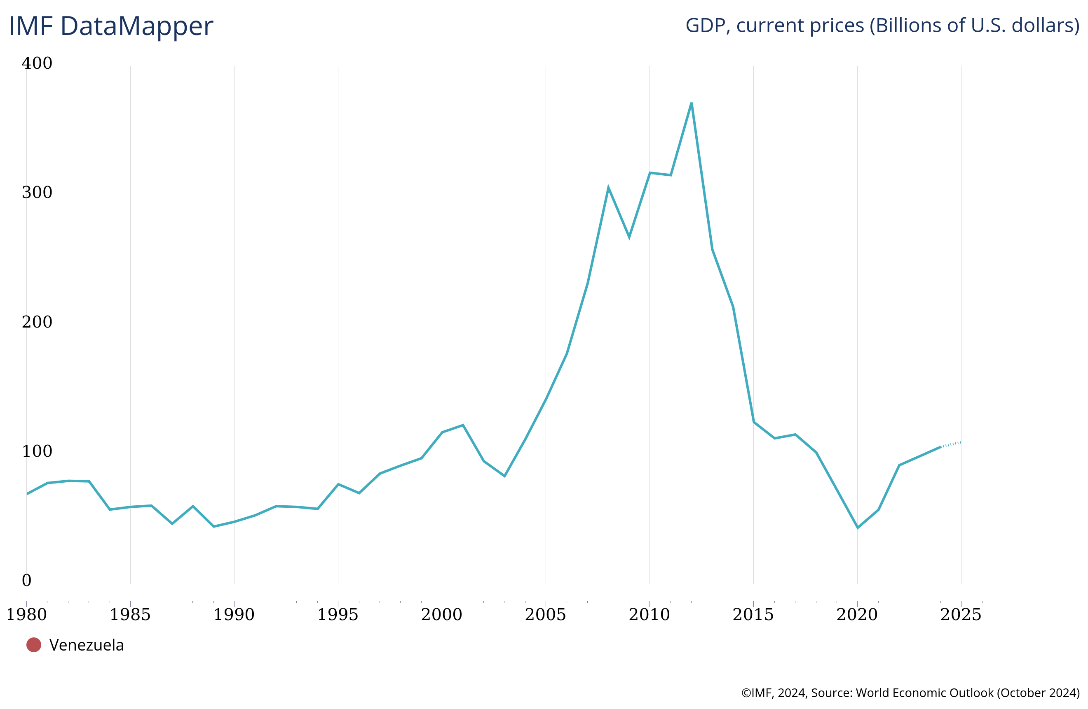
Even if the growth turns out as expected, the economic situation in Venezuela is catastrophic: the country’s GDP has shrunk drastically since peaking in 2012, with current GDP not even reaching half of previous levels. The economic growth in recent years is merely a small rebound following a dramatic collapse.
The average salary in Venezuela is approximately $110 per month, with a significant disparity between the private and public sectors—private sector salaries are reported to be four times higher [3]. The low dollar values of wages and regulated goods illustrate the transition from a relatively high-income country in Latin America to one of the poorest, highlighting the Cubanization of the economy.
The severe contraction in economic activity over the last twelve years, which includes four years of hyperinflation (2018 to 2021), has driven poverty rates to alarming levels. A survey (ENCOVI) indicates that poverty affected 50% of the population in 2023 [4]. Although poverty peaked at 75% in 2018, the recent decline in poverty rates has stagnated. The devastation is such that it will require several years of significantly higher growth rates for recovery to be felt. Even with inflation decreasing, it remains at levels that continue to harm the economy. The IMF estimates that annual inflation may end 2024 below 100% for the first time in a decade.
Oil remains a key source of foreign currency for Venezuela. Recent data shows an increase in oil exports to the U.S. and India, while China remains the main destination. By August 2024, trade between the U.S. and Venezuela reached its highest volume since 2018, with exports amounting to nearly $4 billion and imports at approximately $2.7 billion [5]. More than a decade ago, those figures, which accumulated over eight months, corresponded to the trade of only one month. This increase in commercial relations, resulting from a relaxation of sanctions, may change if the next U.S. administration adopts a tougher stance on Venezuela.
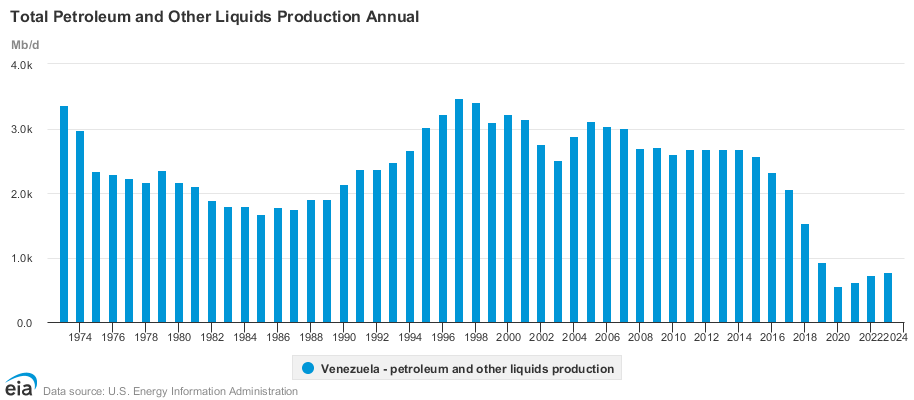
Oil production has risen in recent years, reaching nearly 900,000 barrels per day in 2024—the highest level since 2020—but this is still only a fraction of the production levels from a decade ago [6]. Despite Venezuela leading the rankings in proven oil reserves, it ranked 22nd in production in 2022 [7]. Years of corruption, mismanagement, and economic crises have led to this situation. The current state reflects the economic debacle while simultaneously representing a potential opportunity to drive growth.
The economic, social, and institutional collapse in Venezuela has led to large-scale emigration. Over the past decade, it is estimated that nearly 8 million Venezuelans have left the country—a significant number considering it has a population of approximately thirty million. Following the events of July 28, further migration is expected. Venezuela is one of the few countries that has recorded a decline in total population over the past decade. This is part of the phenomenon of Cubanization. In Cuba, the population has remained stable for three decades, although there has been an increase in the labor force (people over 15 years old with the potential to work).
In contrast, Venezuela’s labor force in 2023 is the same as it was in 2004—an unusual phenomenon for a country without war or natural disasters.
While this outflow of people negatively impacts growth potential, many migrants send remittances back to their families in Venezuela, which have become increasingly essential. In 2023, remittances exceeded $4 billion, representing about 5% of the GDP [8]. According to the Encovi survey, 94% of these funds are used for food highlighting their critical importance for many households.
Recognition of Maduro’s self-proclaimed victory in the recent elections by Russia, China, Iran, and other countries, mostly under theocratic regimes and contrary to U.S. interests, reaffirmed an alliance. However, a new risk has emerged for Venezuela in the region, as Brazilian President Lula da Silva refused to accept Venezuela as a member of BRICS at the last meeting in October, cooling bilateral relations.
Venezuela’s economic situation is complex and precarious. The interplay of political repression, economic mismanagement, and external factors poses significant challenges for recovery.
The current trajectory suggests a continuation of the “Cubanization” of the Venezuelan economy, and increased dependency on authoritarian regimes.
The absence of institutional reforms and the persistence of Maduro’s regime create substantial barriers to economic development. While a rebound in oil prices could provide temporary relief, it will not address the deeper structural issues facing the economy.
References
[1] Human Rights Council Fifty-Seventh Session, Report of the Independent International Fact-Finding Mission on the Bolivarian Republic of Venezuela,” October 2024. https://www.ohchr.org/sites/default/files/documents/hrbodies/hrcouncil/sessions-regular/session57/advance-versions/a-hrc-57-57-en.pdf.
[2] International Monetary Fund, World Economic Outlook: Policy Pivot, Rising Threats. Washington, DC. October 2024.
[3] Observatorio Venezolano De Finanzas. Accessed October 30, 2024. https://observatoriodefinanzas.com/.
[4] Universidad Católica Andrés Bello, Encuesta Nacional de Condiciones de Vida 2023, Caracas, Venezuela, March 2024. https://assets.website-files.com/5d14c6a5c4ad42a4e794d0f7/65f8aa0a4054c8b7a93fe274_Presentacio%CC%81n%20ENCOVI%202023%20integrada%20prensa%20v1303%20(1).pdf
[5] United States Census Bureau, “Trade in Goods with Venezuela“, Accessed October 20, 2024. https://www.census.gov/foreign-trade/balance/c3070.html.
[6] Reuters, Venezuela’s oil exports hit a 4-year peak on higher output, sales to US, India, Accessed October 23, 2024. https://www.reuters.com/business/energy/venezuelas-oil-exports-hit-4-year-peak-higher-output-sales-us-india-2024-11-01/.
[7] U.S. Energy Information Administration, Total energy production from petroleum and other liquids 2022, Raking. Accessed October 22, 2024. https://www.eia.gov/international/rankings/country/VEN?pa=288&u=2&f=A&v=none&y=01%2F01%2F2022
[8] Manuel Orozco and Patrick Springer, 2023 in Remittances: The Year in Review Washington, DC: Inter-American Dialogue, December 2023. https://www.thedialogue.org/wp-content/uploads/2023/12/2023-in-Remittances-The-Year-in-Review.pdf
