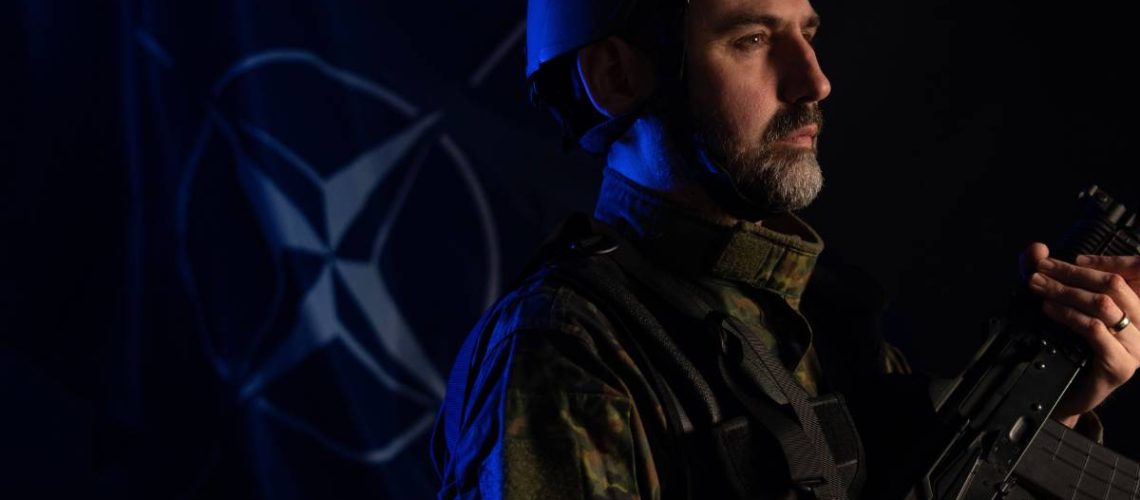

The motto “stronger together” was first used as the main theme for NATO Warsaw Summit, July 8-9, 2016, to underline the importance of the Alliance’s collective strength. The same motto was chosen to encapsulate NATO’s strategic communication and public diplomacy campaign in Washington Summit, July 8-11, 2024, marking the 75th anniversary of the Alliance. But are we (NATO member states) still ‘together’ and how much ‘stronger’ in 2025, especially after the assumption of office by Donald J. Trump (Jan 2025)?
Since its creation on 4 April 1949, the transatlantic Alliance has grown from 12 founding members to 32 member countries. ‘A community of Allies bound together by common values of democracy, individual liberty, human rights and the rule of law’ [[1]], NATO celebrated its anniversary on 4 April at NATO Headquarters and at the Washington Summit, where its founding treaty was signed.
The phrase “Keep the Russians out, the Americans in, and the Germans down” is a well-known saying attributed to Lord Ismay [[2]], the first Secretary General of NATO. He used it in the early 1950s to summarize the purpose of NATO after its formation in 1949. What the first Secretary General meant, was that the establishment of the North Atlantic Treaty Organization was to limit the Soviet expansion and influence in Europe, to ensure a strong “transatlantic” link, with the continuous commitment of the United States in European defense and security and to prevent the resurgence of German militarism after World War II.
After the collapse of the iron curtain, and the dissolution of the Cold War era NATO’s military counterweight, the Warsaw Pact, the Alliance went through an existential transformation and managed to ‘survive’ the criticism of the ‘90s vis-à-vis its role and eastwards expansion, and to maintain a steady pace by addressing global issues of interest for the western world.
The massive terrorist attacks on the United States on the 11th of September 2001, highlighted a new “raison d’ etre” for the Alliance, with the first ever invoke of Article 5 of the Treaty [[3]], requested by the USA, and the consequent NATO Operation Enduring Freedom (October 2001), targeting al-Qaeda and the Taliban regime in Afghanistan. NATO allies participated in that operation, contributing forces and resources. 9/11 reshaped the alliance’s focus, as it highlighted the need for NATO to address non-traditional security threats, such as terrorism, and adapt to the changing global security landscape. Therefore, NATO focused on new and emerging threats (cyber-attacks, disinformation, energy and climate challenges) and fostered global partnerships with like-minded countries.
The problem for the Allies was that the mindset and the consequent strategic and operational planning shifted completely from the traditional warfighting capability to a more “operationalized” problem solving approach. The hybrid warfare and the new and emerging challenges were at the epicenter of the political and military thinking in both sides of the Ocean. Moreover, the political and military “neutralization” of the former leader of the “Eastern Block”, led Europe to heavily rely on the Russian cheaper hydrocarbons, aspiring that – eventually – the former giant will be incorporated into the western security infrastructure.
When Putin’s revisionism started to question the world order as “dictated” by the winning side of the Cold War in the ‘90s, with the 8-day war in Georgia (August 2008) [[4]] the alarm did not – apparently – wake the Allies, especially after the ‘reset’ button pressed by the Obama administration in 2009. The Russian re-emerging as a second global superpower, solidifying its vital space in Central Asia and Caucasus and exporting influence in Eastern Europe was underestimated, and the next move should have been expected: The annexation of Crimea (March 2014) [[5]] was a self-fulfilling prophecy. NATO now had to reconsider its inaction and start to refocus on the conventional and nuclear warfighting, that was left aside for more than two decades. There was a massive revision of the contingency operational planning and – at the same time – a non-coordinated effort of the Allies to lessen the energy dependency on Russian exports.
The full-scale invasion of Ukraine (February 2022) was the straw that broke camel’s back: Now the enemy was clearly (re)defined and the war in European soil, 77 years after the second world war was a fact. Both America, under Biden’s administration and NATO declared that we are “stronger together” in countering Russian aggression and although Ukraine is not a member, NATO reaffirmed its unwavering support, including military aid, training, and long-term security commitments to help Ukraine defend itself. That fact enabled Ukraine to sustain the war for more than 3 years, and not only to counter Russian’s aggression, but also to launch a counter offensive in Russian soil; thus, inflicting severe casualties also to the Russian side.
However, the change in the American administration came to question that unified stance. The “businessman approach” by DJT, who exerts pressure on Ukraine to sign a controversial deal on the exploitation of its rare earths [[6]], in exchange for the military and financial support of the last three years, is far from being within the spirit and the values of democracy, individual liberty, human rights and the rule of law, set in Washington Summit in 1949.
While the new administration opens fronts with America’s closest Allies, like Canada, the European Union, as such, remains far from being capable to fill the gap on Ukrainian soil.
The Alliance’s cohesion and solidarity is at stake, like never before, and its future is unknown. New POTUS’ predicted unpredictability, leads NATO in unchartered waters: Not only does he exserts enormous pressure to the European Allies to – rightfully – share the ‘security burden’ by raising the defense expenditure to almost 5% of their GDP but also, he remains obsessed on dealing with political issues from a businessman perspective.
The non-politically correct “televised fight” in the oval office with President Zelensky (28 Feb 25) [[7]], was (yet another) cold shower for the European NATO member states’ leaders, that showed we are – hopefully – on a decision-making crossroads rather than a deadlock. Therefore, the European Allies need to improvise: The back-to-back visits of both President Macron (24 Feb) and PM Starmer (27 Feb) seem to open a window of opportunity to mend the broken ties in both sides of the Atlantic.
The future of NATO is hard to predict. In his interview to “The Times” (UK) and “Bild” (Germany) on January 15, 2017, President Trump called – in extremis – NATO “obsolete”. Although some foretell its demise, the Alliance is too large and too precious to fail. It will remain the main military apparatus, ensuring the cohesion of the Western World, even if the European Allies must increase their “fair share” of its budget. The operational autonomy of the EU is far from being near, while the global actors are getting stronger. There is more to win than to lose for the Allies, by staying “together”, even if not much “stronger”, as the developments in Ukraine clearly demonstrated.
REFERENCES
-
NATO’s 75th Anniversary, https://www.nato.int/cps/en/natohq/224100.htm ↑
-
Lord Hastings Lionel Ismay (1887-1965), was a prominent British statesman and military officer. He was the Chief of Staff to Winston Churchill during World War II and became the first Secretary General of NATO from 1952 to 1957,
https://www.nato.int/cps/en/natohq/declassified_137930.htm?utm_source=chatgpt.com ↑
-
Often referred to as the collective defense clause, meaning that an armed attack against one or more NATO members is considered an attack against all members, and each member is obligated to take action to assist the attacked party.
Katherine Yon Ebright, “NATO’s Article 5 Collective Defense Obligations Explained” Brennan Center for Justice, November 15, 2022,
https://www.brennancenter.org/our-work/research-reports/natos-article-5-collective-defense-obligations-explained?utm_source=chatgpt.com ↑
-
The conflict primarily took place in the breakaway regions of South Ossetia and Abkhazia, which are internationally recognized as part of Georgia but had been de facto independent with Russian support since the early 1990s. The outcome was a significant blow to Georgia’s territorial integrity and its aspirations for NATO membership.
Ketevan Chincharadze, Larry P. Goodson, “The Enduring Impact of the 2008 Russo-Georgian War”, December19, 2024,
https://warroom.armywarcollege.edu/articles/enduring-impact/?utm_source=chatgpt.com ↑
-
Sergey, Saluschev, “Annexation of Crimea: Causes, Analysis and Global Implications”, UC Santa Barbara, Global Societies Journal, 2014 https://escholarship.org/uc/item/5vb3n9tc ↑
-
Rare Earth Elements (REEs), are a group of 17 chemically similar metallic elements, rarely found in concentrated, economically exploitable forms. They are critical in many high-tech applications due to their unique magnetic, luminescent, and electrochemical properties.
The Guardian, “What are rare earth elements, and why does Trump want them from Ukraine?”, February 5, 2025,
https://www.theguardian.com/us-news/2025/feb/05/donald-trump-rare-earths-ukraine-us-trade-deal-aid-russia?utm_source=chatgpt.com ↑
-
Newsweek, “How Zelensky’s White House Visit With Trump Unraveled in Real Time”, Mar 1, 2025,
https://www.newsweek.com/how-zelenskys-white-house-visit-trump-unraveled-real-time-2037983?utm_source=chatgpt.com ↑

