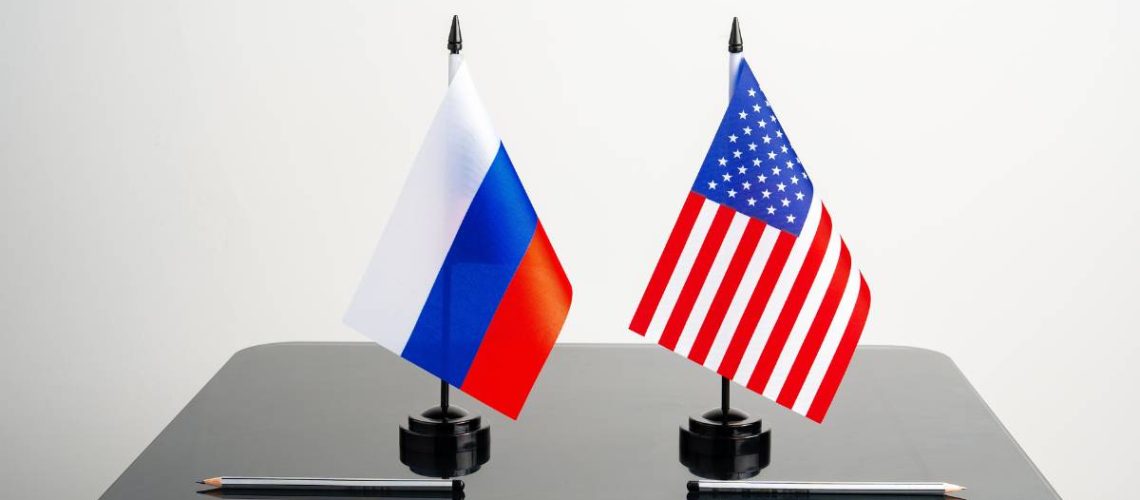

On February 18, 2025, US and Russian representatives met in Riyadh, following a conversation between President Donald Trump and Russian President Vladimir Putin on February 12. While the meeting produced limited results, consisting of pledges to continue work to address various issues and laying the groundwork for future cooperation on matters of mutual economic and geopolitical interest, and the resolution of the Russo-Ukrainian War, its larger impact may be more far reaching.
The Riyadh meeting represents a critical juncture in the Ukraine conflict, signaling a shift in the US role from being a party (albeit indirect) to the conflict to mediator. Further, the redirection of US policy on the Ukraine conflict, indicates a more fundamental shift. Unlike his predecessor, President Trump is indicating that he does not view the weakening of Russia as, necessarily, a priority of US policy.[[1]] This shift should not come as a surprise to anyone. In his interview with Megyn Kelly, Secretary of State Marco Rubio, basically sounded the death knell for a policy that has been a central feature of US foreign policy since the end of the Cold War—the pursuit of American primacy.[[2]] In noting the end of the unipolar moment, Rubio stated that “it’s not normal for the world to simply have a unipolar power. You were going to reach a point where you had a multipolar world, with multiple great powers in different parts of the planet.” He added, “The Chinese will do what’s in the best interests of China, the Russians will do what’s in the best interest of Russia, and the United States needs to do what’s in the best interest of the United States.”[[3]] With that, Rubio broke with a decade-long tradition of downplaying the strategic interests of other states and acknowledged the need to find an accommodation with US adversaries.
In part, the shift in the US position can be seen as an acknowledgment of the reality of the Ukraine conflict. Since the failed Ukrainian offensive in 2023, with Russian forces steadily advancing, now controlling approximately 20 percent of Ukrainian territory,[[4]] and Ukraine running out of troops and plagued by desertions[[5]], it has become widely accepted that Ukraine is losing the war[[6]] Further, there is growing discontent among the American public with the continued support for the war effort. According to the Pew Research Center there has been an increase in those who believe the US has been giving too much aid to Ukraine, increasing to 30% from 7% in 2022.[[7]]
In broader terms, this change in policy can be viewed as a response to rising multipolarity and an effort to exert some control over the inevitable. The world is changing. While the new world order has yet to emerge, one thing is clear—the old ways no longer work. A more assertive South, the rise of alternative non-Western dominated economic structures, such as BRICS+, increased technological competition, and the rise of alternative power centers, are changing the global balance. The US cannot escape this, so it needs to find a way to control the transformation. More importantly, the effort to maintain US primacy is putting an ever-increasing burden on the US military and economy. The current defense budget is approaching a trillion dollars[[8]] and many point out that the US military is seriously overstretched, with current commitments undermining US military readiness.[[9]] With Donald Trump’s election, an argument can be made that the US public is more interested in rebuilding domestically than maintaining US primacy.
In this context, the current effort of the US to recast itself as the mediator in the Ukraine war seems a logical first step to a true transformation of US policy to accommodate a multipolar world. But there are implications to this new role. Europe has been put on notice and will need to recalibrate its position, both militarily and economically, or else it will be sidelined.[[10]] Current European military spending, combined, is 312.83 billion. While that is an increase from the past several years, it is still dwarfed by the US at 916 billion.[[11]] Importantly, there doesn’t seem to be too much consensus in Europe, as the recent meeting in Paris showed. Despite a lot of talk about peacekeepers, no agreement was reached. Nor was there much progress made on French President Macron’s calls for a more unified and increased defense production, as each country continues to be very protective of its own industry and keen not to overburden its population with taxes and cuts in social spending.[[12]]
The recalibration of the US role can have wide-ranging implications. If successfully implemented, it will allow the US to focus more on its domestic issues which have been mounting and rebuild its economy to compete more effectively with rising powers, specifically China. Further, it will allow the US to finally focus on Asia, where it has tried to “pivot”, with limited success for years. Still the success of this initial recasting lies in any future negotiation between the US and Russia and, consequently and on how Russia responds to any US overtures. Will Russia agree to the kinds of compromises that will be required, or will it use the talks to buy time? Finally, the big test will be China. If the US is to successfully embrace multipolarity it will have to make its peace with a rising China.
REFERENCES
- Julian Borger, “Pentagon Chief’s Russia Remarks Show Shift in US’s Declared Aims in Ukraine,” The Guardian, April 25, 2022, https://www.theguardian.com/world/2022/apr/25/russia-weakedend-lloyd-austin-ukraine. ↑
- Michael Mandelbaum, Mission Failure: America and the World in the Post-Cold War Era (New York: Oxford University Press, 2016). ↑
- https://www.state.gov/secretary-marco-rubio-with-megyn-kelly-of-the-megyn-kelly-show/ ↑
- The Visual Journalism Team, “Ukraine in Maps: Tracking the War with Russia,” BBC News, February 13, 2025, https://www.bbc.com/news/world-europe-60506682. ↑
- Harrison Kass, “Is Ukraine Running out of Soldiers to Fight Russia?,” The National Interest, November 25, 2024, https://nationalinterest.org/blog/buzz/ukraine-running-out-soldiers-fight-russia-213354. ↑
- Anatoly Kurmanaev and Constant Méheut, “Ukraine Is Losing Fewer Soldiers than Russia – but It’s Still Losing the War,” The New York Times, January 23, 2025, https://www.nytimes.com/2025/01/23/world/europe/ukraine-russia-soldiers-loss.html. ↑
- Moira Fagan, “Americans’ Views of the War in Ukraine Continue to Differ by Party,” Pew Research Center, February 14, 2025, https://www.pewresearch.org/short-reads/2025/02/14/americans-views-of-the-war-in-ukraine-continue-to-differ-by-party/. ↑
- Chris Edwards, “Defense and Veterans Spending Tops $1.2 Trillion ,” Cato.org, February 5, 2025, https://www.cato.org/blog/defense-veterans-spending-tops-12-trillion. ↑
- Kathryn Levantovscaia, “Overstretched and Undersupplied: Can the US Afford Its Global Security Blanket?,” Atlantic Council, January 5, 2024, https://www.atlanticcouncil.org/blogs/new-atlanticist/overstretched-and-undersupplied-can-the-us-afford-its-global-security-blanket/. ↑
- “Lavrov Points to Uselessness of EU Countries’ Presence at Ukraine Talks,” Известия, February 17, 2025, https://en.iz.ru/en/1840453/2025-02-17/lavrov-points-uselessness-eu-countries-presence-ukraine-talks. ↑
- World Bank Group Data ↑
- Anatol Lieven, “Paris Summit Was Theater, and Much Ado about Nothing,” Responsible Statecraft, February 20, 2025, https://responsiblestatecraft.org/paris-summit-ukraine/. ↑

