
The author of this article is Sarah Dahanni
“Road freight, trucks, trailers, and smaller commercial vehicles, is the backbone of inland logistics across the Middle East.”
Even where rail exists or is planned, trucks handle most door‑to‑door movements, connect hinterlands to ports and airports, and provide flexibility when sea or air corridors are disrupted.
As of the mid‑2020s, the Middle East freight trucking market is valued at roughly USD 155 billion, with forecasts pointing to continued expansion through 2030 [1], driven by expanding e-commerce, large-scale public infrastructure projects, and growing cross-border trade. In the Gulf Cooperation Council (GCC), road freight accounts for close to 39% of freight‑transport revenue, within a freight and logistics market projected to grow from about USD 83.2 billion in 2025 to USD 89.3 billion in 2026 and over USD 120 billion by 2031, underlining road’s central role in the regional logistics mix [2]. Forecasts for the broader transport sector suggest that road freight volumes in the GCC will continue to grow in the mid‑single‑digits annually as governments invest in logistics zones, bonded corridors, and digital solutions for fleet management and customs clearance.
Structurally, road freight offers three key advantages in the region:
- Flexibility and reach: Trucks can serve landlocked zones, border communities, and conflict‑affected areas where rail or pipelines are absent or damaged.
- Speed over medium distances: For intra‑GCC and Levant trade, road transit times are often shorter than coastal shipping once port handling and feeder schedules are considered.
- Redundancy for maritime chokepoints: When Hormuz, Bab al‑Mandeb, the Red Sea, or the Eastern Mediterranean are threatened, overland corridors provide partial relief by re‑routing containers and high‑value cargo through alternative ports and borders. The 2023–2026 waves of disruption around the Strait of Hormuz, the Red Sea, and the Suez Canal have already pushed cargo toward Saudi Red Sea ports, Egyptian Red Sea crossings, and GCC road corridors, confirming this redundancy function in practice.
i. How Dependent Are Middle Eastern Economies on Road Freight?
Across the region, road is the dominant inland freight mode, with rail and inland waterways still playing marginal roles.
- In Saudi Arabia, a recent logistics brief reports 331.3 million tonnes of maritime freight versus only 15.6 million tonnes by rail in 2024 [3] and concludes that domestic logistics “still rely heavily on road distribution networks” for inland movement between ports, industrial zones, and cities.
- In the UAE, the energy minister stated that in 2023, 22% of all non-oil trade by value, about AED 576.4 billion (USD 156.9 billion), was transported by road, supported by a “world-class national road network” linking ports, airports, and logistics zones [4].
- For Jordan, the government’s long-term transport strategy says the freight industry “heavily depends on road transport” and that regional freight to, from, or through Jordan is currently concentrated on road transport, with about 75% of regional traffic flows passing through the port of Aqaba and then moving inland by truck [5].
- In Turkey, statistics show approximately 90% of total freight is transported by road, with only about 5% by rail and 5% by maritime on domestic routes, making it one of the most road-dependent economies in its wider region [6].
- In Lebanon, there is effectively no freight rail, and a system dynamics study notes that road freight already accounted for 30.6% of total transport energy use and 31.4% of road transport GHG emissions in 2010 [7], confirming that almost all freight energy is tied to trucks.
Transit and mixed economies, such as Egypt, Jordan, Turkey, Lebanon, and Iraq, therefore combine their own import/export needs with roles as overland bridges. Turkey links Europe and Eurasia to the Middle East through extensive road and rail corridors, as well as its Aegean and Mediterranean ports. Iraq’s road network is crucial for reconstruction and for connecting inland oil and agricultural areas to Gulf ports and neighboring markets, yet it is fragmented by insecurity, damaged infrastructure, and overlapping control by state and non‑state actors.

Figure 1: Middle East Map of Railroads [8]
Moreover, Levant economies, Lebanon, Syria, Jordan, and the Israeli Occupation are highly reliant on a mix of sea and road logistics:
- Lebanon depends on road links from Beirut and Tripoli ports to the Syrian border and beyond, with limited alternatives when ports or crossings are disrupted.
- Jordan uses the port of Aqaba as its main maritime outlet but relies on road links to Saudi Arabia, Iraq, and the Israeli Occupation to maintain trade flows and diversify routes.
- The Israeli Occupation relies on Mediterranean ports such as Haifa and Ashdod, but inland distribution and cross‑border trade with Jordan and Egypt are truck‑based, forming part of broader Eastern Mediterranean and IMEC‑type corridor concepts.
ii. What Moves by Road, and Why It Matters?
A regional Middle East & Africa trucking report shows dry/bulk goods (grains, cement, construction materials, general cargo) hold the largest share, while temperature‑controlled goods (pharmaceuticals, healthcare products, chilled and frozen food) are the fastest‑growing segment [9]. In Saudi Arabia, road freight is described as essential for distributing “manufactured goods, consumer goods, industrial supplies and agricultural produce” across a very large territory, linking production centers, distribution hubs, retail networks and end‑consumers [10]. In the GCC more broadly, full‑truck‑load (FTL) shipments, typically large orders of food, FMCG, building materials, and industrial cargo, constitute about 30% of the road‑freight segment and represent its largest share, again underscoring the role of trucks in moving bulk and essential goods [11].
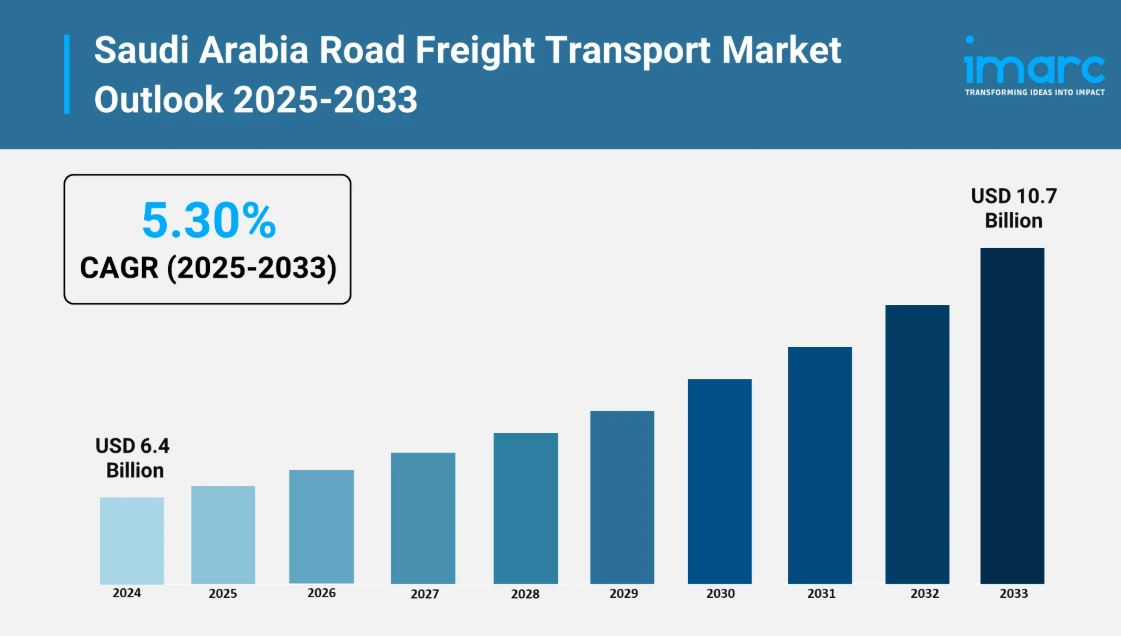
Figure 2: Saudi Arabia Road Freight Transport Market Outlook [10]
For humanitarian and health needs, the UN World Food Programme (WFP) notes that aid operations in the region rely heavily on trucks: every year, supply‑chain teams map out roads, ports, and airfields, and current disruptions in Hormuz and Suez have sharply increased fuel costs, directly affecting trucking and shipping operations on a global scale [12]. In Gaza, for example, WFP reports that food supplies currently enter almost entirely by truck; after a ceasefire, about 750 metric tons of food per day were entering, but this remained far below the 2,000‑ton daily target because only two road crossings were open and access to the main north–south Salah al‑Din Road was blocked. This shows concretely how access to a handful of road corridors determines whether civilians receive enough food [13].
From a military and security perspective, analysis of regional conflicts shows that fuel, ammunition, fighters and illicit goods often move along the same road corridors as commercial traffic; Chatham House, for example, emphasizes how cross‑border trucking routes in Iraq, Syria, Lebanon and Jordan are used by armed groups and smugglers, making road networks central not just to trade but to the logistics of conflict itself [14]. This dual‑use character means that closing or targeting roads has immediate military as well as humanitarian and economic implications.
iii. Key Road Corridors and Border Routes
1 – GCC highway grid and intra-Gulf Trade
In the GCC freight market, road transport accounts for roughly 39% of freight‑transport revenue, underlining its centrality to Gulf logistics. GCC countries such as Saudi Arabia, the UAE, Qatar, Kuwait, Bahrain, and Oman have invested heavily in multi‑lane highways and modern border terminals, making road freight the primary mode for intra‑GCC goods movement [15]. These routes connect major seaports (Jebel Ali, Khalifa, Dammam, Sohar, Duqm), free zones, and industrial cities with large consumer markets in Riyadh, Jeddah, Dubai, Abu Dhabi, Doha, and Kuwait City.
For land‑poor states like Qatar and Kuwait, road corridors are essential for importing food and consumer goods through Saudi, UAE, or Bahraini ports and for exporting high‑value products (e.g. petrochemicals) to neighbouring markets. Oman, with ports such as Sohar and Duqm on the Gulf of Oman and Arabian Sea, uses road networks to position itself as a lower‑risk logistics alternative that can feed cargo into Saudi and UAE markets without passing through the narrowest parts of Hormuz.
Recent disruptions to Hormuz and Red Sea shipping have led Saudi Arabia, the UAE, Oman, and other GCC states to activate alternative inland logistics corridors, routing containers discharged at Red Sea or east‑coast ports across the GCC by truck under bonded‑transit regimes. Saudi Arabia’s logistics‑corridors programmes link Red Sea ports such as Jeddah and King Abdullah to neighbouring Gulf states via designated trucking routes to Kuwait, Bahrain, Qatar, the UAE, Oman, Iraq, Jordan, and Yemen, allowing shipments to bypass threatened sea lanes
2 – Arabian Peninsula–Levant–Eurasia Land Bridge
North–south and east–west highways connect the Arabian Peninsula to the Levant and onward to Turkey and Europe, forming a land bridge that complements maritime routes:
- Saudi Arabia–Jordan–Turkey corridor: Roads from eastern Saudi ports and logistics hubs run via Riyadh and Tabuk to Jordan’s Al‑Haditha crossing, then onward through Jordan and Turkey to European markets.
- Iraq–Levant axis: Highways link Iraqi cities and border posts to Syria, Lebanon, and Turkey, carrying both licit and illicit trade and serving as critical routes for reconstruction materials and humanitarian aid.
These corridors are central to concepts such as the India–Middle East–Europe Economic Corridor (IMEC), which envisions Indian cargo landing in the UAE and then moving by rail and road across Saudi Arabia and Jordan to Eastern Mediterranean ports and on to Europe. While the formal rollout of IMEC has been uneven since its announcement in 2023, the underlying land‑bridge logic has gained renewed relevance as Gulf states seek more resilient export and transit routes amid repeated maritime disruptions.
3 – Egypt and North African Connections
Within Egypt, road freight connects Mediterranean ports (Alexandria, Port Said), Red Sea gateways (Ain Sokhna, Safaga), and Nile Valley cities, enabling containers, bulk cargo, and LNG‑related equipment to move between industrial zones and export terminals. Overland links from Sinai and the Suez region to the Levant, as well as westward connections toward Libya and deeper into North Africa, position Egypt as a road‑and‑sea junction between Africa, the Arab world, and Europe.
Since 2023, a notable example of this role is the Safaga–Duba sea‑road bridge: trucks drive to Safaga, board ferries to Duba in Saudi Arabia, and then continue overland into Gulf markets, moving around 500 refrigerated containers, roughly 12,500 tons of cargo per day and turning Egypt into a key transit bridge during the current Hormuz and Red Sea disruptions.
4 – Conflict‑Affected and Informal Corridors
In parts of Iraq, Syria, Lebanon, and Yemen, formal road networks overlap with informal and semi‑legal trade routes used by armed groups, militias, and local traders. These networks move everything from agricultural products (e.g. tomatoes) to narcotics across borders, blurring the lines between licit and illicit trade and exposing logistics operations to extortion, checkpoint fees, and security risks. Understanding these corridors is essential for grasping how conflict and sanctions reshape regional economies.
iv. Route Reliance and Alternatives by Country
- Saudi Arabia is doubling down on an inland east–west strategy that combines pipelines, rail, and road to reduce exposure to Gulf Sea lanes. The East–West Pipeline (Petroline) now moves up to about 7 million barrels per day from eastern fields to Yanbu on the Red Sea, while the Saudi Landbridge rail project and a new 1,700 km freight corridor to the Jordan border are designed to shift freight between Red Sea and Gulf coasts and on to neighboring states.
- The UAE is leveraging east‑coast ports and pipelines, plus inland dry ports, to create a structured bypass around Hormuz. The Abu Dhabi Crude Oil Pipeline directs exports to Fujairah on the Gulf of Oman, while Corakan and Fujairah act as alternative container gateways linked by motorway and “green corridors” to inland hubs and to Saudi Arabia and Oman.
- Qatar, lacking pipeline outlets beyond the Gulf, has focused on strengthening land access via Saudi Arabia. A new Saudi land‑transit route using TIR and the Al‑Nadeeb digital customs platform offers fast‑track lanes and simplified procedures for trucks entering via the Saudi border, explicitly framed as contingency planning to sustain trade flows during maritime disruptions.
- Kuwait remains one of the most exposed exporters and is pursuing long‑term overland connectivity through a planned Kuwait–Riyadh rail link and potential integration with corridors to Oman’s Duqm/Ras Markaz, aiming to diversify away from pure Gulf loading. Iraq is more actively pursuing inland export routes: an Iraq–Jordan pipeline to Aqaba, revival of Kirkuk–Ceyhan, and the Development Road corridor from Grand Faw to Turkey all aim to reduce reliance on Gulf loadings and shorten transit to Europe.
- Iran is both the gatekeeper of Hormuz and a state seeking its own bypasses. The Goreh–Jask pipeline moves crude to the Gulf of Oman, avoiding the Strait, while expanded road and rail links with Iraq, Turkey, Pakistan, Afghanistan, and the South Caucasus help sustain trade via regional partners.
- Oman positions itself as a natural bypass state, with deep‑sea ports at Sohar, Duqm, and Salalah on the Gulf of Oman and Arabian Sea connected by upgraded highways and customs links to Saudi Arabia and the UAE. Cargo can be landed on Oman’s ocean‑facing coast and trucked into the GCC without entering the Strait.
- Egypt is developing seven integrated logistics corridors by 2030, upgrading road and rail connections between Ain Sokhna, Alexandria, Damietta, Safaga, inland industrial and mining regions, and border crossings, aiming to capture Gulf flows that are being rerouted toward the Red Sea and Mediterranean and to serve as a land bridge to Europe.
- The Israeli Occupation is promoting itself as a potential Mediterranean outlet for Gulf energy and trade within IMEC concepts, while Jordan is consolidating its role as the most stable overland Gulf–Levant corridor through new Saudi rail freight links and proposed joint corridor governance. Lebanon remains highly dependent on Beirut and Tripoli, plus road links into Syria, but repeated strikes and closures reveal minimal redundancy when both sea and land arteries come under pressure.
- Turkey is expanding its role as a Eurasian and Middle Eastern land bridge through investments in the Middle Corridor and partnership in Iraq’s Development Road, offering overland alternatives that reduce reliance on both Hormuz and Russian routes.
v. What Happens When Road Freight Is Disrupted?
Because dependence on roads is so high, closures or serious degradation of road freight have rapid, measurable effects on food security, prices, transit revenues, and macro‑stability.
- In Gaza, when access to main road corridors is restricted, WFP has shown that daily food deliveries fall from a target of 2,000 tons to about 750 tons, a 62.5% shortfall, simply because only two crossings are open and trucks cannot use the principal north–south road.
- In the GCC, Saudi Arabia’s Red Sea ports and road network have become the “main alternative logistics corridor in the Gulf during wartime and a lifeline for other GCC countries”, especially for fresh produce; if these inland corridors were themselves blocked, Qatar, Bahrain, Kuwait, and Oman would immediately lose their main wartime supply route, leaving only much slower and costlier alternatives.
- In Jordan, where about 70% of regional flows go through Aqaba and then move inland by truck, a major closure of the Aqaba–Amman corridor or links to Saudi Arabia and Iraq would effectively shut down the majority of transit trade and choke off imports of fuel, food, and manufactured goods.
- In Saudi Arabia, the imbalance between huge seaborne volumes and limited rail capacity means any serious disruption to road transport, fuel shortages, security issues, or infrastructure damage would ripple quickly through the entire economy.
- In the UAE, where a large share of non‑oil trade already moves by road, shocks to the road network would impair its role as a regional distribution hub; precisely for this reason, projects like Etihad Rail are being advanced to relieve over‑reliance on trucks.
- In Turkey, with roughly 90% of freight moved by road, simulations of modal shift show that any big constraint on trucking forces freight either onto a much smaller rail/maritime base or into more expensive modes, with knock‑on effects on inflation and industrial output.
Chatham House stresses that because so much regional freight and contraband moves by road, closing or re‑routing road corridors also reshapes transnational conflict economies: armed groups lose or gain control over taxation points, states lose customs revenue, and local populations may be cut off from both licit and illicit goods. When main highways in Syria or Iraq are closed or militarized, legal trade diverts to longer, riskier routes or collapses altogether, while smuggling and black‑market prices spike.
Finally, these patterns of dependence, corridor development, and country-level strategies feed directly into the region’s risk profile and its responses, as seen in the 2023–2026 crises around Hormuz, the Red Sea, and Suez that have forced large-scale, truck-based rerouting of cargo.
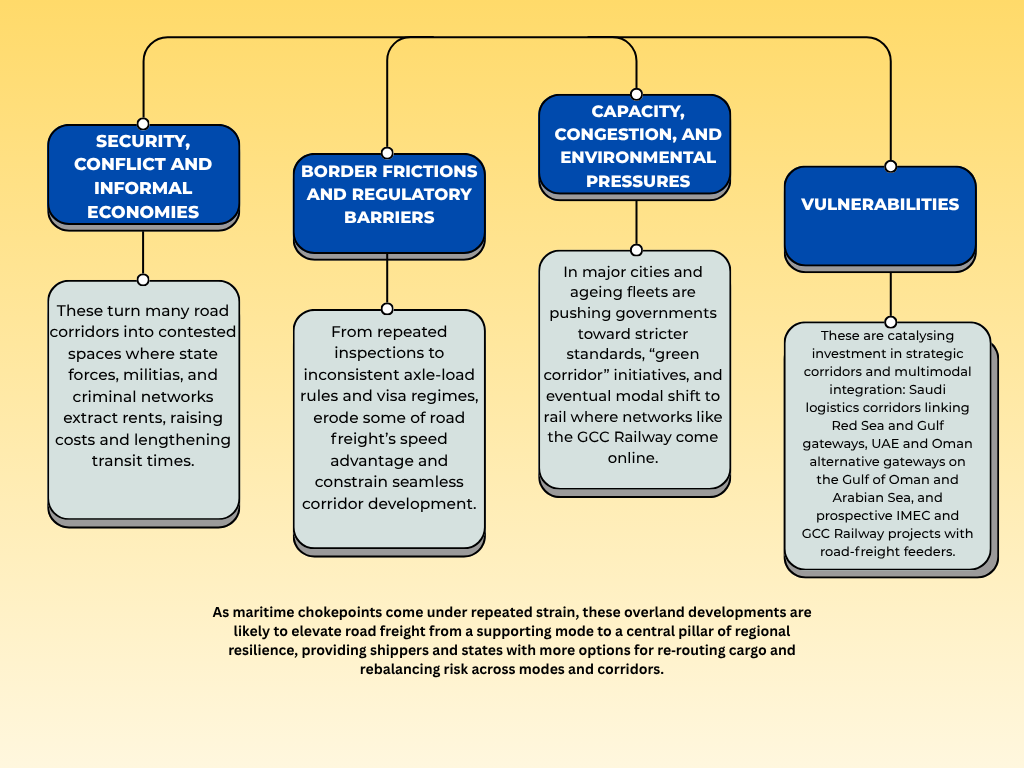
Figure 3: Analysis by the Author
Notes
[1] Ken Research, ‘Middle East Freight Trucking Market Report Size Share Growth Drivers Trends Opportunities & Forecast 2025–2030’, January 2026 https://www.kenresearch.com/middle-east-freight-trucking-market
[2] Mordor Intelligence, ‘GCC FREIGHT AND LOGISTICS MARKET SIZE & SHARE ANALYSIS – GROWTH TRENDS AND FORECAST (2026 – 2031)’, https://www.mordorintelligence.com/industry-reports/gcc-freight-and-logistics-market
[3] Ken Research, ‘How Saudi Arabia’s USD 45 Billion Logistics Market Is Evolving Beyond Traditional Freight?’, 25 March 2026 https://www.kenresearch.com/articles/saudi-arabia-logistics-trends-air-cargo-forecast
[4] Dubai Eye, ‘Energy Minister: 22% of non-oil trade transported by road’, 10 October 2024 https://www.dubaieye1038.com/news/business/minister-22-of-non-oil-trade-transported-by-road-in-2023/
[5] ITA, ‘75% OF JORDAN’S IMPORTS, EXPORTS PASS THROUGH AQABA’S PORTS — ASEZA CHIEF’, 14 December 2025 https://www.ice.it/it/news/notizie-dal-mondo/297224
[6] Loder, ‘Logistics Industry in Turkey’, 2014 https://www.transportevents.com/presentations/Istanbul14/IsmailKarakis.pdf
[7] Research Gate, ‘System dynamics modeling for mitigating energy use and CO2 emissions of freight transport in Lebanon’, 2019 https://www.researchgate.net/publication/338739769_System_dynamics_modeling_for_mitigating_energy_use_and_CO2_emissions_of_freight_transport_in_Lebanon
[8] UIC, ‘The Middle East Region’, 06 March 2014 https://uic.org/com/IMG/pdf/presentation_of_middle_east_region.pdf
[9] Precision Business Insights, ‘Middle-East And Africa Freight Trucking Market Size, Share, Growth, Trends, and Industry Analysis: By Cargo (Dry/Bulk Goods, Temperature Controlled Goods, & Hazardous/Dangerous Goods), By Type (Flatbed Truck, Closed Box & Refrigerated, & Curtain Side), By Product (Low To Medium Truck Load (LTL) and Full Truck Load (FTL)), By End User Industry (Consumer Goods, Hi-Tech, Oil & Gas, Pharmaceutical & Healthcare, Chemicals, Food & Beverages, and Others), and Country Forecast 2021-2032’, October 2024 https://www.precisionbusinessinsights.com/market-reports/middle-east-and-africa-freight-trucking-market
[10] IMRAC Group, ‘Saudi Arabia Road Freight Transport Market Trends: Navigating Logistics Expansion and Evolving Supply Chain Dynamics’, n.d, https://www.imarcgroup.com/insight/saudi-arabia-road-freight-transport-market-infrastructure-development
[11] RSA, ‘The future of GCC’s road freight sector – growth drivers and stoppers’, 05 April 2026 https://www.rsa.global/blog/future-gccs-road-freight-sector-growth-drivers-and-stoppers
[12] WFP, ‘WFP acts to keep food moving as Middle East conflict escalates’, 06 March 2026 https://www.wfp.org/stories/wfp-action-keep-food-moving-middle-east-conflict-escalates [accessed 06 April 2026]
[13] Arab News, ‘Food flows into Gaza still far below targets, WFP says’, 21 October 2025 https://www.arabnews.com/node/2619658/middle-east [accessed 06 April 2025]
[14] Chatham House, ‘How supply chains fuel transnational conflict in the Middle East’, 2024, https://www.chathamhouse.org/2024/11/how-supply-chains-fuel-transnational-conflict-middle-east
[15] Mordor Intelligence, ‘GCC FREIGHT AND LOGISTICS MARKET SIZE & SHARE ANALYSIS – GROWTH TRENDS AND FORECAST (2026 – 2031)’, https://www.mordorintelligence.com/industry-reports/gcc-freight-and-logistics-market
