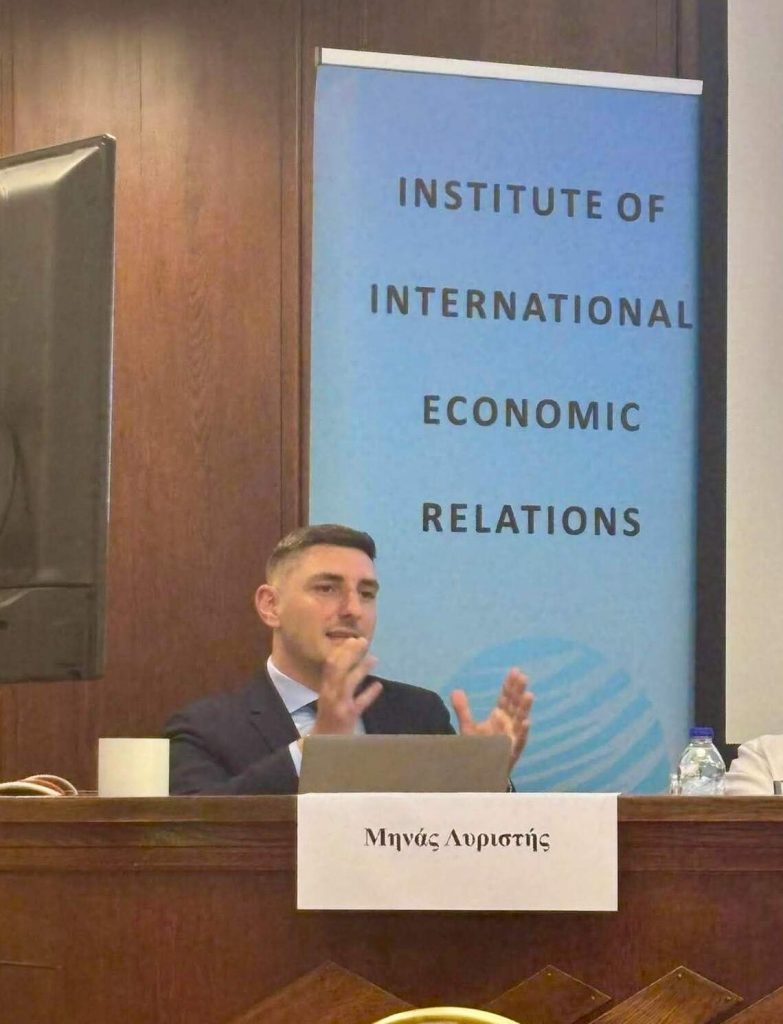
Strategy International highlights the recent participation of our Junior Scholar for Gulf Affairs, Dr. Minas Lyristis, in the fourth edition of the Mare Mediterraneum conference, entitled Mare Mediterraneum IV.
The conference brought together academics, researchers, policy analysts and specialists in international affairs to discuss the evolving geopolitical dynamics of the Mediterranean, the Middle East and the wider international system. Now in its fourth consecutive year, Mare Mediterraneum has established itself as a platform for substantive dialogue, analytical exchange and interdisciplinary reflection on the strategic challenges shaping the region.
Dr. Lyristis participated with a presentation entitled “The Conflict in Iran and its Implications for Saudi Arabia’s Strategy.”
In his intervention, Dr. Lyristis examined how instability and conflict involving Iran affect Saudi Arabia’s strategic calculations, particularly in relation to regional security, deterrence, energy politics, diplomatic positioning and the broader balance of power in the Middle East. He underlined that Saudi strategy cannot be understood solely through the prism of bilateral rivalry with Iran, but must be analysed within a wider regional environment shaped by shifting alliances, great-power competition, economic transformation and the search for strategic autonomy.
Particular attention was given to the way Riyadh seeks to balance confrontation, de-escalation and pragmatic diplomacy. Dr. Lyristis argued that Saudi Arabia’s approach reflects a broader effort to protect national security interests, preserve domestic transformation priorities, and strengthen its role as a central actor in the emerging regional order.
Beyond his contribution as a speaker, Dr. Lyristis also served as a member of the conference’s Organising Committee, contributing to the preparation and successful completion of the event together with his colleagues. The successful organisation of Mare Mediterraneum IV reflects the importance of sustained academic and policy-oriented dialogue on the Mediterranean and the Middle East at a time of profound geopolitical uncertainty.