ICT Corridors, Energy Corridors, and Geopolitical Instability: A Comparative Interpretation, by Elias Aravantinos
The ICT‑driven corridor model in the figure helps illustrate how geopolitical instability can disrupt interconnected systems, much like the current Middle East war is destabilizing key energy corridors. The triangular ICT‑flow model shows that when a central hub is destabilized—whether in digital corridors or energy corridors—the shock radiates outward along every connected pathway, forcing states to rethink alliances, upgrade technological capacities, and redesign their strategy for maintaining stability in a rapidly changing geopolitical environment.
Cluster 3 (the technology and capital provider) functions the same way Iran, the UAE, or Saudi Arabia function inside energy corridors: they are not just participants; they are systemic hubs. If that hub is destabilized, every dependent pathway loses reliability. It affects all flows simultaneously because every relationship is anchored through the same node. This is identical to how conflict affecting Iran or attacks on the UAE ripple across oil export routes, shipping lanes, insurance costs, regional investment flows, and other interlinked systems.
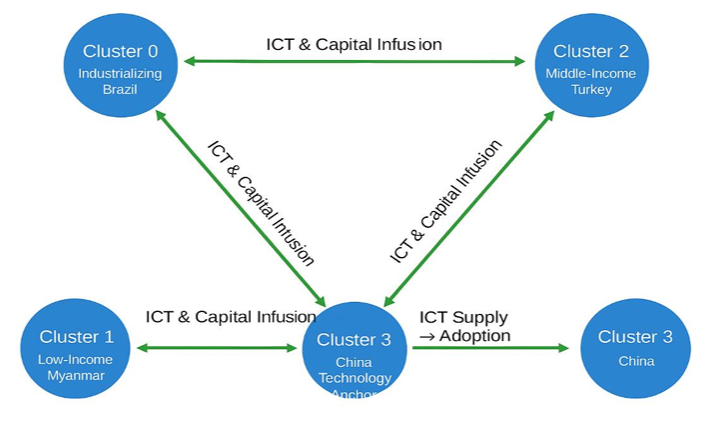
New strategic behavior emerges under stress, as the model helps illustrate why, when a central node is destabilized:
• dependent nodes seek new alliances,
• they diversify their partnerships,
• they strengthen defensive or technological capabilities,
• and regions reorganize around alternative corridors.
This parallels how Gulf countries react to conflict by:
• forming new regional alignments,
• renegotiating security guarantees,
• and investing in technology‑based defense systems and clean‑energy diversification.
Because ICT is the “currency” of the triangle:
• digital infrastructure,
• cybersecurity,
• and information networks
become essential to maintaining flow stability.
Similarly, in Middle East conflicts:
• drones, AI‑driven targeting, cyber operations, and satellite monitoring
are reshaping the strategic landscape — meaning shocks propagate faster and the role of technology becomes central to both stability and instability.
Reference:
Forecasting ICT-Driven Trade Competitiveness 2024–2028: A Cluster and Scenario Analysis, Elias Aravantinos, https://arxiv.org/abs/2601.00842

Elias Aravantinos
Commentary – ICT Corridors, Energy Corridors, and Geopolitical Instability: A Comparative Interpretation
ICT Corridors, Energy Corridors, and Geopolitical Instability: A Comparative Interpretation, by Elias Aravantinos
The ICT‑driven corridor model in the figure helps illustrate how geopolitical instability can disrupt interconnected systems, much like the current Middle East war is destabilizing key energy corridors. The triangular ICT‑flow model shows that when a central hub is destabilized—whether in digital corridors or energy corridors—the shock radiates outward along every connected pathway, forcing states to rethink alliances, upgrade technological capacities, and redesign their strategy for maintaining stability in a rapidly changing geopolitical environment.
Cluster 3 (the technology and capital provider) functions the same way Iran, the UAE, or Saudi Arabia function inside energy corridors: they are not just participants; they are systemic hubs. If that hub is destabilized, every dependent pathway loses reliability. It affects all flows simultaneously because every relationship is anchored through the same node. This is identical to how conflict affecting Iran or attacks on the UAE ripple across oil export routes, shipping lanes, insurance costs, regional investment flows, and other interlinked systems.
New strategic behavior emerges under stress, as the model helps illustrate why, when a central node is destabilized:
• dependent nodes seek new alliances,
• they diversify their partnerships,
• they strengthen defensive or technological capabilities,
• and regions reorganize around alternative corridors.
This parallels how Gulf countries react to conflict by:
• forming new regional alignments,
• renegotiating security guarantees,
• and investing in technology‑based defense systems and clean‑energy diversification.
Because ICT is the “currency” of the triangle:
• digital infrastructure,
• cybersecurity,
• and information networks
become essential to maintaining flow stability.
Similarly, in Middle East conflicts:
• drones, AI‑driven targeting, cyber operations, and satellite monitoring
are reshaping the strategic landscape — meaning shocks propagate faster and the role of technology becomes central to both stability and instability.
Reference:
Forecasting ICT-Driven Trade Competitiveness 2024–2028: A Cluster and Scenario Analysis, Elias Aravantinos, https://arxiv.org/abs/2601.00842
Author
DISCLOSURE
All written content of this article on this site is the exclusive copyright and property of Strategy International (SI) Ltd and the author who has written to It.
To note, the opinions stated do not necessarily reflect the official policies of Strategy International.
No prior use in part or in its complete form, written, words, maps, charts or statistical, numerical information can be made, unless there is a written prior request and consent by the author and Strategy International and its legal representative.
All requests should be directed at info@strategyinternational.org
Search
Recent Articles
Topics
Categories