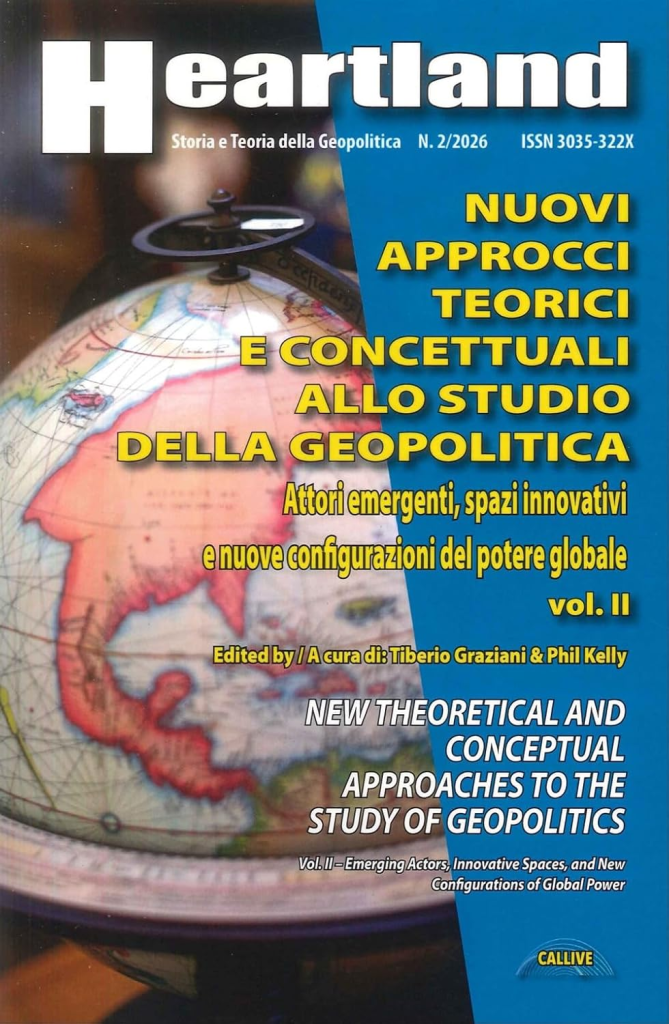

Strategy International is proud to announce the publication of a new academic chapter by our Junior Scholar, Dr. Minas Lyristis. The chapter is featured in the newly released compilation, NEW THEORETICAL AND CONCEPTUAL APPROACHES TO THE STUDY OF GEOPOLITICS VOL. II – Emerging Actors, Innovative Spaces, and New Configurations of Global Power (published as part of the Heartland series, edited by Tiberio Graziani and Phil Kelly).
In his contribution, titled “Beyond the failed state: The insurgent statelet as a tool for geopolitical analysis,” Dr. Lyristis provides a critical examination of concentrated non-state power and challenges traditional Western paradigms of international relations. His analysis deconstructs state-centric normative labels, such as “failed state” or “terrorist group,” arguing that these categories obscure the true nature of emerging political orders in conflict zones. Instead, Dr. Lyristis rehabilitates the concept of the “insurgent statelet,” demonstrating how these entities function as sophisticated, de facto state-builders that fundamentally alter regional and global security architectures.
Key highlights of Dr. Lyristis’s chapter:
- Critique of traditional frameworks: Challenges incumbent, state-centric terminology that limits the geopolitical understanding of non-state actors.
- The ‘insurgent statelet’ paradigm: Introduces a robust analytical framework to view rebel territorial organizations not as mere expressions of destructive nihilism, but as active constructors of governance.
- Empirical case studies: Applies the framework to two structurally similar but ideologically antithetical cases: the Autonomous Administration of North and East Syria (AANES/Rojava) and the Islamic State (ISIS).
- 21st-century dynamics: Explores how these statelets master modern survival strategies, including parallel digital bureaucracies, the use of dual-use technologies (such as commercial drones and 3D printing), and informal diplomacy for sanctions evasion.
- Strategic implications: Warns that the international system is increasingly populated by de facto sovereignty builders whose strategic repercussions can no longer be ignored or analyzed solely through the narrow lens of the war on terror.
This publication reflects Strategy International’s ongoing commitment to rigorous, evidence-based research that provides innovative conceptual frameworks for understanding the asymmetric and hybrid nature of contemporary global power.
Access the publication here: https://www.amazon.it/-/en/concettuali-geopolitica-metodologia-geopolitica-contemporanea/dp/B0GP5VMZ2Q/