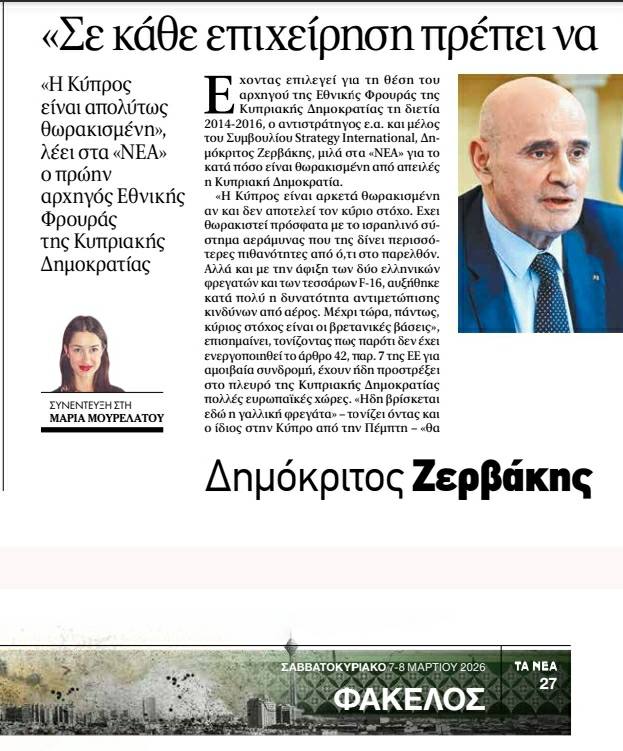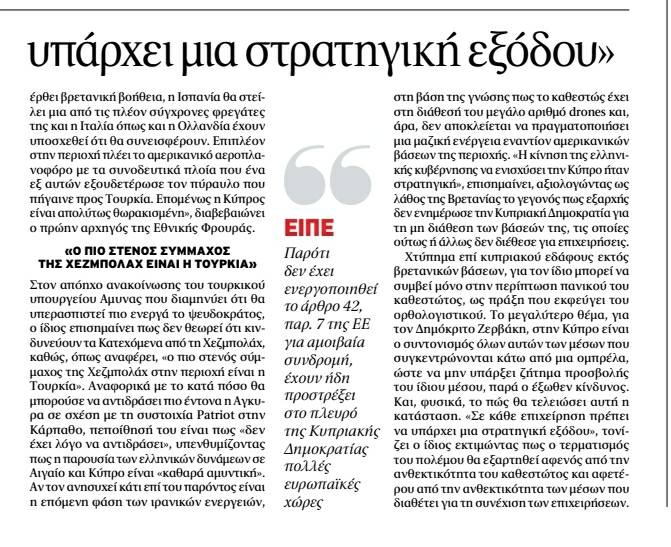

In an interview with the Greek newspaper Ta Nea – Weekend Edition, conducted by diplomatic correspondent Anna Mourelatou, Lieutenant General (ret.) Dimokritos Zervakis, Advisory Board member of Strategy International Ltd., addressed in brief key strategic and security issues related to the Eastern Mediterranean and the Republic of Cyprus.
Lt. Gen. Zervakis stressed that any war or military campaign must incorporate a clearly defined exit strategy, noting that the termination of the Iran conflict ultimately depends on the resilience of the political regime involved. He underlined that such resilience should not be conflated with the regime’s military capacity to continue fighting, as political endurance and battlefield capability represent distinct dimensions of strategic sustainability.
In the context of the Republic of Cyprus’ security architecture, Zervakis characterized the deployment of Greek forces for the defensive coverage of the island as a strategic option. He further assessed that the Republic of Cyprus with the related support a number of European countries can sufficiently address potential threats. He made reference to the Mutual Defence Clause, Article 42.7 of the Treaty on the European Union, indicating though that the up to date threat was directed against the Sovereign British Bases.
Regarding the security outlook in the Turkish-occupied territory of the Republic of Cyprus, Zervakis argued that these areas are unlikely to face immediate risk under current conditions. He linked this assessment to the broader geopolitical environment, noting that Turkey remains one of the most significant supporters of Hezbollah after Iran, a factor that influences regional alignments and the strategic calculations of actors involved in the wider Middle Eastern security landscape.Overall, Zervakis’ analysis highlights the need for integrated strategic thinking combining military planning, political resilience, and regional geopolitical dynamics.