

An article by Jerome Vitenberg
Introduction: Déjà Vu Before the Fall
In a 2013 TED talk, Greek Prime Minister George Papandreou reflected on how deep-seated transparency problems hampered the country and how the fiscal data he inherited had been manipulated in the years before [1]. Indeed, in the months leading up to Greece’s financial collapse in 2009, international institutions such as the IMF and credit rating agencies issued cautious observations while maintaining ostensibly stable ratings. It was only when the crisis erupted that the narrative abruptly shifted from warning signs to alarm bells—a delay that, by the way, allowed select insiders to prepare, while the majority of the public faced sudden austerity and social upheaval [2].
Today, similar dynamics appear to be unfolding in France. The eurozone’s second-largest economy shows growing signs of fiscal imbalance and political paralysis, yet major international actors remain restrained in their public diagnoses. With warnings growing louder but action still deferred, France may face a sudden financial and political reckoning—potentially after the summer break, as September has historically served as a moment of market and political reawakening [3].
This analysis examines the clouds of the upcoming French economic storm, the fiscal and political warning signs, and the broader economic and geopolitical consequences of a potential French debt crisis. It also outlines how the paralysis in French governance may limit internal remedies and explores the tools available to exposed countries facing the consequences of this looming instability.
Economic Vulnerabilities and Political Instability
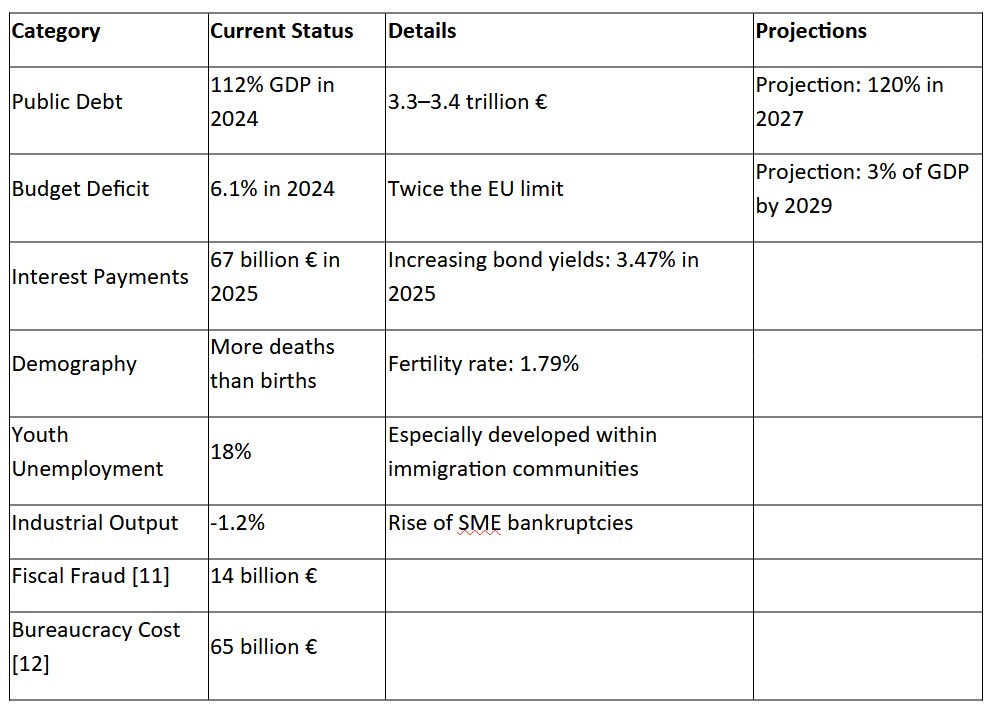
France’s public debt reached 112% of GDP (€3.346 trillion) in 2024 [4], accounting for one-fourth of total EU public debt. The structural public deficit of 6.1% exceeds the EU’s 3% threshold, with debt projected to climb to 120% by 2027. Interest payments are expected to rise from 2.5% of GDP (€67 billion) in 2025 to 3% by 2029, driven by 10-year bond yields at 3.47% [5].
The public pension system faces a €6.6 billion annual deficit, projected to reach €15 billion by 2035 [6], with social protection spending at one-third of GDP [7]. Youth unemployment rose to 18.2% in 2024, potentially reaching 20% by 2027 if GDP growth slows to 0.6%. Industrial output declined 1.2% in 2024 due to high energy costs (€0.25–0.30/kWh), exacerbated by EU energy agreements and sanctions on Russia [8]. Corporate bankruptcies increased 5%, particularly among SMEs [9], and demographic challenges persist with a fertility rate of 1.79 in 2023, where deaths (685,000) exceeded births (678,000) [10].
Summary of Economic Data
Political instability in France has intensified following the 2024 elections, with a fragmented parliament paralyzing efforts to implement critical fiscal reforms, raising the specter of a “motion de censure” that could topple the government. Resistance to pension age increases and proposed tax hikes, within an already heavily taxed system consuming 47% of GDP, has fueled widespread public discontent and strengthened populist parties like National Rally and France Unbowed.
This deepening political crisis, compounded by cultural and economic fractures, could escalate to the point of civil war, as recently warned by David Betz in Military Strategy Magazine, who highlights the risk of violent civil conflict driven by fractured societies and systemic vulnerabilities [13]. The situation is further exacerbated by numerous demonstrations planned across France starting September 2025, with unions and opposition groups mobilizing against austerity measures under the movement “Bloquons tout!” (“Block Everything!”), which risks dwarfing the “Gilets Jaunes” (“Yellow Vests”) movement in scale and impact, as reported by some outlets [14] and echoed in public sentiment on X.
France’s Debt Crisis: Warnings, Economic, and Socio-Political Consequences
In 2010, economist Paul Krugman warned that Europe’s structural vulnerabilities, particularly in Greece, stemmed from unsustainable debt and ignored competitiveness issues, heightening the risk of severe financial crises [15]. In June 2025, the IMF warned that France’s debt trajectory could necessitate a financial tutelage scenario by 2028 without reforms and fiscal discipline, with public debt at €3.3 trillion [16]. Moody’s downgraded France to Aa3 in December 2024 [17], while S&P and Fitch issued cautious alerts, maintaining AA- ratings probably to avoid market panic, but noting negative outlooks and upcoming structural deterioration. French bond yields reached 3.3%, with a 90-basis-point spread over German bonds, the highest since 2012. The ECB’s cessation of sovereign debt repurchasing in January 2025 has increased borrowing costs, with a potential junk status downgrade by 2027 signaling an imminent crisis. The reluctance to act decisively, especially during a politically sensitive summer, may echo the delayed interventions in the Greek crisis. Key stakeholders—including financial institutions and governments—may be attempting to quietly reposition themselves ahead of an expected storm [18].
Economic Consequences
A French debt crisis could push bond yields above 5%, increasing interest payments to 4% of GDP (€120 billion) by 2030, crowding out public spending. French banks, holding €600 billion in sovereign debt, may see non-performing loans rise to 5–6%, requiring €100–150 billion in recapitalization. A GDP contraction of 1–2% annually could mirror Greece’s 25% decline from 2010–2014. A 10–15% euro depreciation by 2028 would inflate import costs, pushing inflation to 3–4%. Corporate defaults and speculative “Frexit” risks could destabilize the eurozone, increasing borrowing costs by 50–100 basis points [19].
France risks a Greek-style tragedy, with tremors threatening Europe and beyond.
Socio-Political Consequences
- Austerity measures, likely mandated by the IMF or EU, could trigger protests similar to Greece’s 2010–2015 riots. Political fragmentation risks boosting populist parties by 10–15% by 2027. Unemployment could reach 10%, with youth unemployment hitting 20–22%, eroding trust in institutions. President Macron’s leadership faces scrutiny, with protests potentially intensifying by 2026 if reforms stall. A full-scale debt crisis would have devastating repercussions:
- Debt Servicing Costs: Could reach 4% of GDP by 2030, crowding out public investment.
- Bank Exposure: With €600 billion in sovereign debt holdings, French banks risk mass NPL growth, especially in SMEs and energy sectors.
- Recession: A GDP contraction of 1–2% annually is possible, mirroring Greece’s decade-long collapse.
- Speculative “Frexit” Risk: Could destabilize eurozone borrowing rates and ECB operations.
- Social Fallout: IMF-imposed austerity would provoke protests, deepen youth unemployment, and empower populist movements. Institutional trust could erode rapidly, risking democratic cohesion [20].
The Domino Effect – Countries Most Exposed
A French debt crisis would significantly impact the eurozone, with specific vulnerabilities for key member states [21].
Germany [22], holding an estimated €500–600 billion in French bonds through the Eurosystem [23], could face €50–100 billion in bank losses, with bond yields rising to 3% and a GDP contraction of 0.5% by 2027 [24]. Italy, with €150–200 billion in French debt, risks non-performing loans increasing to 7–10%, necessitating €20–30 billion in recapitalization [25]. Smaller economies like Cyprus, with €0.5 billion in French debt and €0.8 billion in trade exposure, could see non-performing loans rise to 8–10%, requiring €2–3 billion in recapitalization, exacerbated by energy investments through TotalEnergies [26].
North African countries, such as Algeria and Morocco, reliant on France for 15% of exports, face potential trade and FDI losses of 10–15% by 2028 [27]. Larger economies like the U.S., China, and India remain relatively insulated due to diversified economic structures. The ECB’s exposure, holding €400–500 billion in French sovereign bonds, could trigger systemic eurozone risks, potentially requiring extraordinary interventions [28].
Thus, despite clear fiscal threats, French political fragmentation impedes structural reform. For instance, the likelihood of implementing necessary spending cuts as recommended by the IMF is reduced by half due to the political landscape. The 2025 budget postponed austerity measures, and attempts at raising the pension age or increasing taxes are blocked by entrenched political resistance, undermining investor confidence. A national consensus for reform remains elusive, and reform proposals risk collapsing under political pressure—making IMF tutelage increasingly plausible.
In the summer of 2025, eurozone nations, including Germany, Italy, Belgium, Luxembourg, and Cyprus, are likely diversifying bond portfolios toward dollar-denominated assets and strengthening bank capital buffers to counter potential contagion from a French debt crisis. Concurrently, the U.S. and China are probably preparing contingency plans to address global economic shifts, with particular attention to stabilizing trade and investment ties in regions like North Africa, which could face significant disruptions.
Austerity by Another Name – and a Sovereignty Question
Recent French government measures—such as raising the pension age, taxing private savings, and reducing social benefits—mirror IMF-style austerity conditionalities, yet prioritize productive sectors over reforming the bloated bureaucracy, raising concerns about misaligned priorities.
Beyond the economic crisis and the accountability of state officials, a critical question emerges: who holds France’s €3.3 trillion debt? The Banque de France’s refusal to disclose major foreign creditors, with non-residents holding 52%–54% of public debt, fuels speculation [29].
France’s deepening alignment with Qatar and Saudi Arabia in Middle East foreign policy, including significant Qatari investments and Saudi bond purchases, prompts questions about potential debt-driven diplomatic agreements [30]. Such opacity undermines confidence in France’s sovereignty, both domestically and globally. The IMF, rating agencies, and possibly the ECB appear to grant President Macron a window to implement reforms before potential financial oversight, echoing warnings issued prior to Greece’s 2008 crisis [31].
Conclusion
“Maybe it’s the calm before the storm,” President D. Trump remarked in the White House State Dining Room on October 5, 2017, a prescient echo now shadowing France’s future. As the nation’s fiscal path falters—burdened by pension deficits and escalating bureaucratic costs—political paralysis stifles decisive action, risking a crisis that could erupt imminently, possibly under external oversight. Economist Marc Touati, with courage and perseverance, has long sounded the alarm, only to face dismissal from state officials claiming superior wisdom. While France lingers in its 2025 summer repose, European nations—Germany, Italy, Cyprus, and North African partners—likely scramble to shield themselves from cascading repercussions. Beyond fiscal fragility, France’s undisclosed foreign creditors and shifting diplomatic ties veil a deeper erosion of sovereignty, exposing its opacity and political fault lines. At a crossroads between its storied grandeur and crushing debt, France risks a Greek-style tragedy, with socio-political tremors that could ripple across Europe and beyond.
REFERENCES
- George Papandreou, “Imagine a European Democracy without Borders,” TEDGlobal, June 2013, https://www.ted.com/talks/george_papandreou_imagine_a_european_democracy_without_borders.
- Julie Creswell and Graham Bowley, “Ratings Firms Misread Signs of Greek Woes,” New York Times, November 30, 2011.
- Marc Touati, “Faut-il craindre une dégradation de la note de la dette française ?” Merci pour l’info, April 25, 2024, https://www.mercipourlinfo.fr/actualites/argent/faut-il-craindre-une-degradation-de-la-note-de-la-dette-francaise-1059700.
- Institut National de la Statistique et des Études Économiques (INSEE), March 27, 2025, https://www.insee.fr/en/statistiques/8099742.
- Banque de France, “Macroeconomic Projections for France,” December 2024, https://www.banque-france.fr/en/statistics/macroeconomic-projections.
- Cour des Comptes, “Situation financière et perspectives du système de retraites,” February 20, 2025, https://www.ccomptes.fr/fr/publications/situation-financiere-et-perspectives-du-systeme-de-retraites.
- Debt Clock France, “Public Spending,” updated 2025, https://www.horloge-de-la-dette-publique.com/en/public-spending/.
- Banque de France, “Macroeconomic Projections for France,” December 2024, https://www.banque-france.fr/en/statistics/macroeconomic-projections.
- Debt Clock France, “Public Spending,” updated 2025, https://www.horloge-de-la-dette-publique.com/en/public-spending/.
- Institut National de la Statistique et des Études Économiques (INSEE), “Demographic Bulletin,” 2024, https://www.insee.fr/en/statistiques/7732950.
- Debt Clock France, “Public Spending,” updated 2025, https://www.horloge-de-la-dette-publique.com/en/public-spending/.
- Marc Touati, “La prochaine crise financière viendra de France,” Info du Jour, June 26, 2025, https://www.infodujour.fr/economie/75754-marc-touati-la-prochaine-crise-financiere-viendra-de-france/.
- David Betz, “Civil War Comes to the West, Part II: Strategic Realities,” Military Strategy Magazine 10, no. 2 (Spring 2025): 6–16.
- Solenne Bertrand, “« Un arrêt total et illimité du pays » : c’est quoi ce mouvement qui appelle à bloquer la France « à partir du 10 septembre » ?” Le Parisien, July 22, 2025.
- Paul Krugman, “The Euro Trap,” New York Times, April 29, 2010, https://www.nytimes.com/2010/04/30/opinion/30krugman.html.
- International Monetary Fund, “France: Staff Concluding Statement of the 2025 Article IV Mission,” May 22, 2025, https://www.imf.org/en/News/Articles/2025/05/22/mcs052225-france-2025-article-iv-mission.
- Financial Times, “Moody’s Downgrades France to Aa3 as Fiscal Woes Mount,” December 15, 2024, https://www.ft.com/content/moody-downgrades-france-aa3-fiscal-woes-2024.
- Marc Touati, “La prochaine crise financière viendra de France,” Info du Jour, June 26, 2025, https://www.infodujour.fr/economie/75754-marc-touati-la-prochaine-crise-financiere-viendra-de-france/.
- Marc Touati, “La prochaine crise financière viendra de France,” Info du Jour, June 26, 2025, https://www.infodujour.fr/economie/75754-marc-touati-la-prochaine-crise-financiere-viendra-de-france/.
- Marc Touati, “La prochaine crise financière viendra de France,” Info du Jour, June 26, 2025, https://www.infodujour.fr/economie/75754-marc-touati-la-prochaine-crise-financiere-viendra-de-france/.
- European Central Bank, “Financial Stability Review, November 2020,” https://www.ecb.europa.eu/pub/financial-stability/fsr/html/ecb.fsr202011~b0f8d86f3e.en.html.
- Bloomberg, “Germany Faces Economic Strain from Eurozone Debt Risks,” January 10, 2025, https://www.bloomberg.com/news/articles/2025-01-10/germany-faces-economic-strain-from-eurozone-debt-risks.
- Deutsche Bundesbank, “Government Debt in the Euro Area: Developments in Creditor Structure,” 2021.
- Oxford Economics, “France on the Brink Drives Spreads to Crisis Highs,” December 5, 2024, https://www.oxfordeconomics.com/resource/france-on-the-brink-drives-spreads-to-crisis-highs/.
- European Central Bank, “Financial Stability Review, November 2020,” https://www.ecb.europa.eu/pub/financial-stability/fsr/html/ecb.fsr202011~b0f8d86f3e.en.html.
- Central Bank of Cyprus, “Financial Stability Report 2024,” December 2024, https://www.centralbank.cy/en/publications/financial-stability-report.
- World Bank, “MENA Economic Update: Trade and FDI Impacts,” April 2025, https://www.worldbank.org/en/region/mena/publication/mena-economic-update.
- European Central Bank, “Financial Stability Review, May 2023,” https://www.ecb.europa.eu/pub/financial-stability/fsr/html/ecb.fsr202305~c52b6a36c5.en.html.
- Banque de France, “France’s International Investment Position, Q4 2024,” March 2025, https://www.banque-france.fr/en/statistics/balance-payments/international-investment-position.
- Reuters, “France Deepens Gulf Ties Amid Economic Pressures,” October 20, 2024, https://www.reuters.com/world/middle-east/france-deepens-gulf-ties-amid-economic-pressures-2024-10-20/.
- International Monetary Fund, “France: Staff Concluding Statement of the 2025 Article IV Mission,” May 22, 2025, https://www.imf.org/en/News/Articles/2025/05/22/mcs052225-france-2025-article-iv-mission.
