
1. Introduction: The Indo-Pacific as the Fulcrum of Systemic Realignment
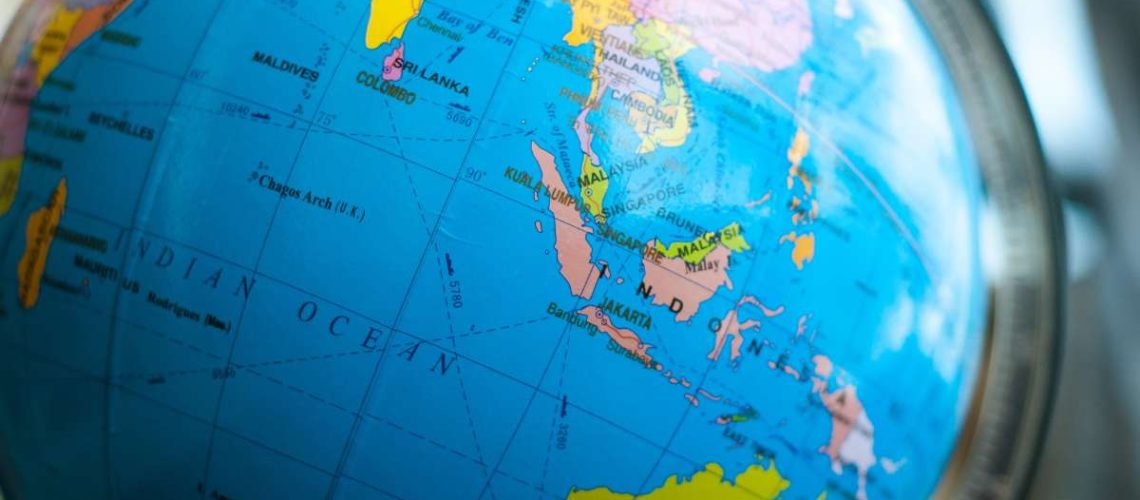
The Indo-Pacific, stretching from the Arabian seaboard through the Indian Ocean and Australasia to the Pacific coastlines of the Americas, now anchors the reconfiguration of international-system structure. Its strategic geography no longer turns solely on chokepoints like the Strait of Hormuz or the South China Sea. Guam, the Northern Marianas, Hawaii, and the central Pacific now figure prominently. This widening geostrategic arc signals that rivalries today are shaped not merely by territorial contests, but by architectures—narrative, infrastructural, regulatory—that cut across regions and crystallize systemic shifts.
The Indo-Pacific is not simply a theatre of U.S.–China friction; it is an active site of configuration. India, the ASEAN states, and the Pacific Islands all operate there, each with its own strategic syntax. These actors are not buffers or swing states. Rather, they refashion the strategic grammar through infrastructural, institutional, and informational systems that shape future global arrangements.
On one side stands the Anglosphere’s maritime arc, built out through AUKUS, the Quad, and bilateral initiatives. On the other is China’s dual maritime–continental posture, embodied in the Belt and Road Initiative (BRI) and its associated digital and financial extensions. Yet outcomes do not depend solely on these two poles. India and ASEAN neither mimic nor mediate them; rather, they modulate, redirecting flows, recoding alignments, and embedding plural alternatives within emerging structures.
2. Strategic Infrastructures and Maritime Systems: Contested Architectures
Infrastructure now functions as a marker of strategic presence. BRI corridors link Gwadar, Hambantota, and Djibouti through ports and pipelines designed for economic utility and latent civil–military interface. This maritime projection underwrites a logistical presence that shapes regional perception of initiative and capacity.
Meanwhile, the Anglosphere’s response has moved beyond containment. It promotes infrastructural diversification through the Quad’s Critical Minerals Initiative, AUKUS technology-sharing, and U.S.–Japan port development plans.[1] India’s Mumbai–Chabahar–Central Asia axis intersects here, integrated via European funding platforms and converging logics of redundancy and reach.
In this changing context, sea-lane dominance no longer ensures primacy. The South China Sea retains strategic centrality, and over 80 percent of China’s oil imports transit it, but dominance is contested.[2] The U.S. Seventh Fleet shares waters with assertive Chinese deployments and an increasingly capable Indian Navy. Strategic depth now arises from redundancy: routes, platforms, and partnerships layered to limit vulnerability.
3. Strategic Communications and Institutional Layering
The Indo-Pacific’s information space does not merely mirror strategic flux, but refracts and amplifies it. Education, language networks, media flows, and migratory circuits constitute infrastructure as much as fiber-optic cables do.
The Anglosphere maintains structural advantage through open systems: English-language education, digital commons, and high-skilled migration channels. These systems underwrite a normative default, even when declarative coherence lags. Political volatility, especially in the United States, may erode symbolic leadership, but the communicative architecture remains participatory and generative.
By contrast, China’s information policy is disciplined and coherent, tethered to its material presence via the BRI. Yet its closed system repels as much as it projects: censorship and surveillance embed mistrust.[3] These asymmetries diffuse its narrative influence in Southeast Asia and the Pacific Islands. There, Chinese media follow Chinese infrastructure, but the political resonance remains tactical rather than systemic.
India’s influence, moving differently, builds upon diaspora ties, pluralistic institutions, and soft-power exports. The Quad STEM Fellowship and Indo-Pacific scholarships circulate Indian educational capital, while digital public infrastructure, governance toolkits, and low-cost service models are offered as discrete, adoptable modules. India does not universalize its system; it proposes a referent for scalable, autonomous development. This modularity coheres with its diplomatic posture: non-aligned, open-textured, and increasingly generative.
4. India and ASEAN: Modulators of Strategic Architecture
India and ASEAN do not oscillate between great powers. They alter the international-system structure itself through infrastructural redirection, regulatory participation, and institutional composition.
India’s strategic posture rejects BRI not from isolationism but from pluralist intentionality. Through SAGAR (Security and Growth for All in the Region), the India–Middle East–Europe Corridor (IMEC), and African engagement, it cross-links Western initiatives without subordinating to them.[4] Civilizational depth and democratic pluralism augment its appeal as a non-prescriptive partner.
ASEAN’s institutional design—consensus, non-interference, polyform layering—allows simultaneous engagements without their collapsing into bloc dynamics. Indonesia, Singapore, and Vietnam operate within RCEP, IPEF, and the ARF to generate strategic capacity without normative overcommitment.[5] Their strategies reflect “polycontextuality”: engagement across systems without determinative allegiance.
These actors do not displace power; they rearrange how it expresses itself by modifying access rules and standard-setting processes. Like Central Asia and the South Caucasus, they operate through architecture, not confrontation.
5. Emerging Convergences and Countervailing Currents
The Indo-Pacific is not cohering around a single platform. Instead, we see the accumulation of partial alignments: AUKUS naval interoperability, Quad logistical taskforces, Japan–ASEAN infrastructure, and India–Africa digital networks.
China moves with velocity and coherence, whereas Western-aligned strategies move more slowly and aggregatively, with transparency and pluralism. The disjuncture creates friction but also options for regional countries. Vietnam, for example, deepens U.S. defense ties while pursuing Chinese economic integration;[6] Indonesia accepts Chinese capital and Japanese industrial partnerships. These hybrid alignments do not represent contradictions but reflect a region translating international-structural tension into relatively autonomous agency.
6. Conclusion: Aligning Strategic Grammar Across Theatres
The Indo-Pacific will not consolidate around a single grammar of order. Its form is additive and plural. Here, infrastructure and institution do not follow alliance but often precede it.
Actors like India and ASEAN do not merely balance. They shape the grammar: deciding what norms circulate, which rules become default, and where initiatives cohere. Their influence lies not in force but in structuring.
They resemble not analogues but counterparts to Poland and the Baltic states in the Euro-Atlantic theatre: structure-modifiers rather than structure-followers. In the Indo-Pacific, however, coherence must arise without hierarchy. This region is where multipolarity becomes policy-modular.
The international system’s contradictions will not be resolved in the Indo-Pacific. What is emerging in the region are the means by which those contradictions may be sustained, redirected, or transformed. The configuration of what follows will influence the evolution of the system as a whole.
REFERENCES
[1]. Department of State, Government of the United States, “Joint Statement from the Quad Foreign Ministers’ Meeting in Washington.” 1 July 2025, https://www.state.gov/releases/office-of-the-spokesperson/2025/07/joint-statement-from-the-quad-foreign-ministers-meeting-in-washington.
[2]. CSIS ChinaPower, “How Much Trade Transits the South China Sea?” https://chinapower.csis.org/much-trade-transits-south-china-sea.
[3]. Kieran Green, Andrew Sprott, Ed Francis, Dr. Brian Lafferty, Hartley Wise, Molly Henry, Grace Faerber, and Frank Miller, Censorship Practices of the People’s Republic of China, Report to the U.S.–China Economic and Security Review Commission ([Vienna, Va.]: Exovera Center for Intelligence Research and Analysis, February 2024), https://www.uscc.gov/sites/default/files/2024-02/Censorship_Practices_of_the_Peoples_Republic_of_China.pdf
[4]. Directorate of Strategy, Concepts and Transformation, Ensuring Secure Seas: Indian Maritime Security Strategy (New Delhi: Integrated Headquarters, Ministry of Defence, Government of India, 26 October 2015), available at https://www.drishtikone.com/content/files/2022/05/Ensuring-Secure-Seas—INDIAN-MARITIME-SECURITY-STRATEGY.pdf. This is the most recent unclassified maritime policy document issued by India’s Integrated Headquarters.
[5]. Shiro Armstrong and Rebecca Sta Maria, “RCEP can be a tool for East Asian organising against protectionism,” 18 May 2025, stratsea (Singapore), https://stratsea.com/regional-comprehensive-economic-partnership-and-the-challenges-of-asean-centrality/.
[6]. Asher Ellis, “Vietnam’s careful US–China balancing act,” 6 June 2025, East Asia Forum (Canberra), https://eastasiaforum.org/2025/06/06/vietnams-careful-us-china-balancing-act/

