

The dynamics of democracy and foreign direct investment (FDI) present an intriguing interplay, particularly when examined across diverse geopolitical landscapes. This relationship has stirred considerable debate among economists and political analysts, especially in the context of emerging markets where the twin drivers of economic growth and political stability are inextricably linked.
The barometer for democracy often hinges on the presence of free elections, rule of law, human rights, and the power structure’s transparency. Conversely, FDI is a critical economic component that fuels growth, enhances productivity, and often demands a conducive environment that ensures investor confidence through political stability and reliable legal frameworks.
Data from 2011 to 2022 reveals a nuanced pattern in countries like Thailand, Bangladesh, China, Egypt, Turkey, and Myanmar, where democracy scores frequently appear negative, while FDI inflows vary significantly (Figure 1). Most notably, Thailand has a pronounced positive FDI score against its low democracy rating. This dichotomy raises pertinent questions about the underlying factors that drive investment decisions in regions with constrained democratic processes.
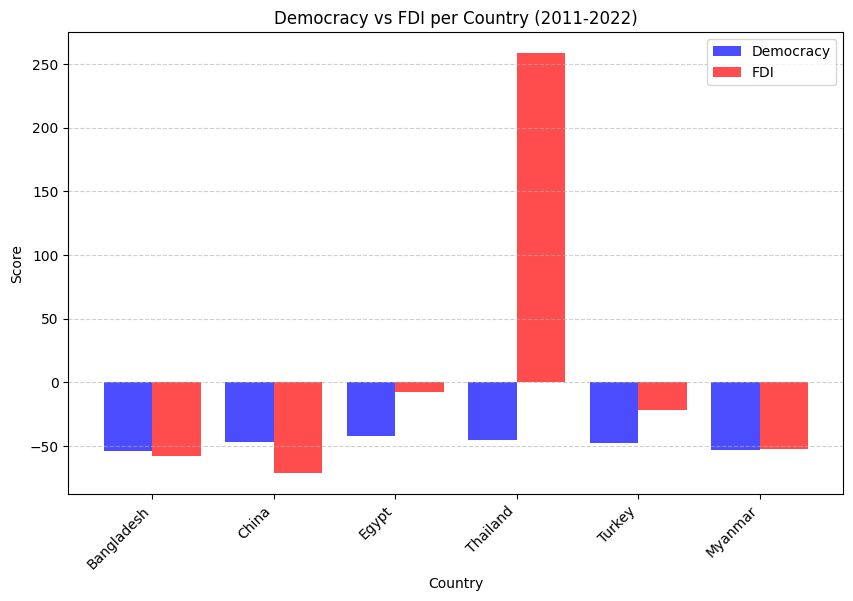
Figure 1: Democracy vs FDI data comparison
Thailand’s Unique Position
Thailand’s noteworthy FDI levels amidst negative democracy scores could be attributed to several factors. Historically, Thailand has positioned itself as a manufacturing hub within Southeast Asia, benefiting from its strategic location, relatively favorable logistics, and integrated value chains in electronics and automotive sectors. The assurance of stable economic policies, despite political upheavals, seems to reassure investors, emphasizing that economic pragmatism can often supersede political idealism in investment decisions.
Contrasting Dynamics in Other Countries
Countries like China and Egypt, although bearing negative democracy scores, register modest FDI compared to Thailand. China’s case is unique given its authoritarian governance model, which paradoxically provides a semblance of stability and predictability that global investors often prioritize. However, the international scrutiny of human rights and trade policies can sometimes impede further inflows.
Egypt, grappling with post-revolution transitions, demonstrates how political uncertainty can dampen investor enthusiasm despite vast market potential and strategic geographic positioning.
Bangladesh and Myanmar depict a more complex relationship. While investor interest in Bangladesh is heightened by its burgeoning textile industry and low labor costs, concerns over political instability and governance continue to pose challenges. Myanmar, with significant untapped resources, faces hurdles due to prolonged political turmoil and international sanctions, restraining its FDI potential.
Turkey’s Balancing Act
Turkey showcases an example of attempting to balance economic objectives with evolving democratic structures. Despite experiencing political and economic turbulence, Turkey’s diversified economy, customs union with the European Union, and strategic location serve as magnets for FDI. Yet, its trajectory underscores the delicate balancing act needed to sustain investor confidence amidst dwindling democratic scores.
Machine learning Models
When comparing different machine learning models of 30 developing economies dataset between the time period, 2011 and 2022, a non-linear relationship is revealed to predict economic growth from several socio-economic and technology variables including Democracy.
| Model | R-squared | RMSE | MAE | C-index |
|---|---|---|---|---|
| XGBoost | 0.9633 | 0.0326 | 0.0144 | 0.8574 |
| LightGBM | 0.8426 | 0.0675 | 0.0369 | 0.7190 |
| CatBoost | 0.9606 | 0.0338 | 0.0159 | 0.8243 |
| Neural Network | 0.5303 | 0.1167 | 0.0674 | 0.5690 |
Table 1: Models’ comparison
XGBoost and CatBoost as described in Table 1, seem to be leading the pack in performance, with higher R-squared values and lower Root Mean Squared Error (RMSE) and Mean Absolute Error (MAE) metrics, while the Neural Network approach shows the weakest results. Both metrics are used to assess the accuracy of regression models, but RMSE emphasizes larger errors more than MAE does. C-index (Concordance Index) is a metric primarily used to evaluate predictive models. XGBoost has the highest C-index (0.8574), meaning it correctly ranks predictions.
CatBoost Model: Democracy is the most influential factor, shaping the model’s predictions. Other significant contributors include Fixed_BB, unemployment, ICT index, inflation rate, and FDI, which collectively indicate that political, economic, and technological elements impact the outcome.
XGBoost Model: Democracy has an even stronger effect solidifying its central role. FDI follows with digital infrastructure components like Fixed_BB and ICT-index playing key supporting roles. Unemployment, inflation, and 4G deployment contribute but with lesser significance.
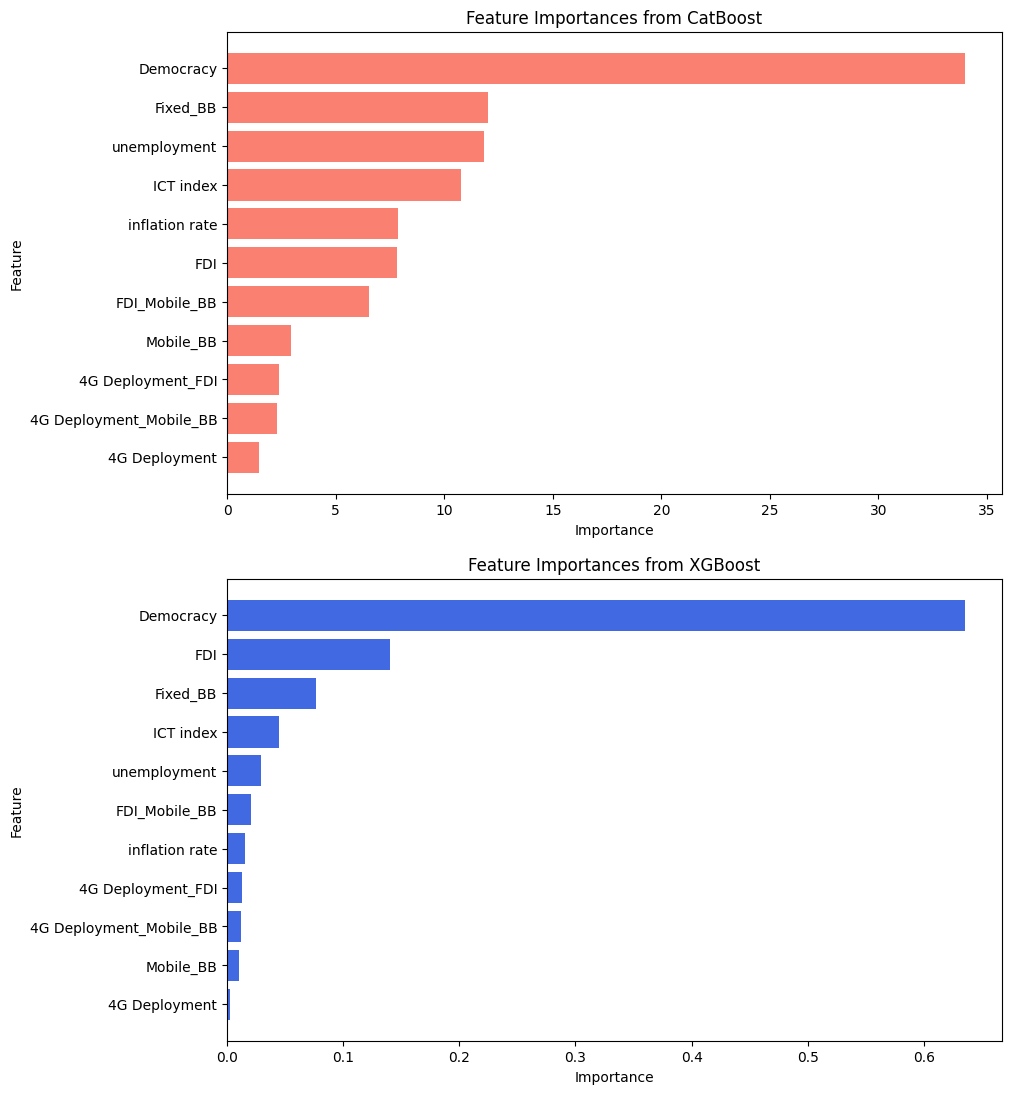
Figure 2: Features importance for CatBoost and XGboost
Both models (Figure 2) agree that Democracy is the primary driver, highlighting its importance in shaping the predicted outcome. Democracy offers better protection of property rights and thereby encourages growth. FDI and technological infrastructure also play essential roles, underscoring the connection between governance, economic investment, and digital development. XGBoost assigns an even greater weight to Democracy, reinforcing the link between political stability and the modeled phenomenon.
In essence, these models collectively emphasize that democratization and foreign investment are the strongest influences, with infrastructure and economic factors supporting the trend. Their consistent findings add confidence to the importance of political and economic stability in shaping outcomes. Democracy οffers better protection of property rights and thereby encourages growth as well as it promotes innovation and technical progress and thus improves results in economic terms.
Conclusions and suggestions
The relationship between democracy and FDI is far from linear. While democratic principles ideally create an environment conducive to sustainable economic development, pragmatic economic policies often take precedence in influencing investor sentiment. Countries like Thailand exemplify how strategic advantages and economic stability can attract substantial FDI despite democratic deficits.
This analysis mandates a deeper understanding of local contexts, emphasizing that investors weigh a matrix of factors—beyond political systems—in their quest to optimize returns. Progressing forward, fostering accountable governance, enhancing transparency, and maintaining economic stability will remain crucial for countries aiming to attract and retain foreign investments, ultimately propelling broader socio-economic advancements.
The research results seem reasonable for emerging economies, considering the dynamics at play. Political stability, represented by Democracy, often serves as a critical foundation for economic growth and investor confidence. In many developing nations, FDI plays a substantial role in accelerating development, making its influence in your models highly logical.
The importance of technological infrastructure—Fixed_BB, ICT index, and 4G deployment—also aligns with global trends, as digital connectivity fosters economic activity, entrepreneurship, and access to global markets. Unemployment and inflation are common macroeconomic challenges for emerging economies, so their moderate influence is expected.
Further analysis is needed to investigate if the emphasis on Democracy differs across regions or economic stages. In some cases, economic factors may overshadow governance, while in others, political stability may be a prerequisite for sustained investment and infrastructure expansion. SI can help political decision-makers to evaluate results and conclusions per country or per region and develop certain regional and political frames and even act on political institutions to promote economic and technological development.
References
- Aravantinos Elias, Dimitris Varoutas, «Clustering Emerging Economies by Broadband Diffusion Trajectories», accepted for publication in ITS 33rd European Conference 2025 · Edinburgh, Scotland, 29th June – 1st July 2025
- Aravantinos Elias, Strategy International (2025, April 7), Unlocking Growth: A Comparative Technoeconomic Analysis of Emerging Economies https://strategyinternational.org/2025/04/07/publication168/
- Ghardallou, W., Sridi, D. Democracy and Economic Growth: a Literature Review. J Knowl Econ 11, 982–1002 (2020). https://doi.org/10.1007/s13132-019-00594-4
- Herrera, G. P., Constantino, M., Su, J. J., & Naranpanawa, A. (2023). The use of ICTs and income distribution in Brazil: A machine learning explanation using SHAP values. Telecommunications Policy, 47(8).
- Kirgiz, O. B., Kiygi-Calli, M., Cagliyor, S., & El Oraiby, M. (2024). Assessing the effectiveness of OTT services, branded apps, and gamified loyalty giveaways on mobile customer churn in the telecom industry: A machine-learning approach. Telecommunications Policy, 48(8).
- Meli, S. D., Djoumessi, Y. F., & Djiogap, C. F. (2022). Analysis of the socio-economic determinants of mobile money adoption and use in Cameroon. Telecommunications Policy, 46(9).
- Prado, T. S., & Bauer, J. M. (2021). Improving broadband policy design using market data: A general framework and an application to Brazil. Telecommunications Policy, 45(4).
- Rath, B. N., Panda, B., & Akram, V. (2023). Convergence and determinants of ICT development in case of emerging market economies. Telecommunications Policy, 47(2).
- Saba, C. S., & David, O. O. (2020). Convergence patterns in global ICT: Fresh insights from a club clustering algorithm. Telecommunications Policy, 44(10).
- Reuters. (2025, January 13). Thailand’s investment applications up 35% to 10-year high. Reuters. https://www.reuters.com/markets/asia/thailands-investment-applications-up-35-10-year-high-2024-2025-01-13/

