
The author of this article is Sarah Dahanni
Why Sea Freight in the Middle East Matters
Maritime transport is the backbone of world trade, carrying over 80% of global goods by volume and more than 70% of their value, according to UN Trade and Development (UNCTAD) [2]. This dominance reflects structural advantages: ships move thousands of containers or millions of barrels of oil in a single voyage at costs per ton‑kilometer far below those of air or road, and they can flexibly reroute as demand, prices, and security conditions shift.
“The Middle East ports and sea lanes handle roughly one‑fifth of global seaborne trade, reflecting its position at the junction of Asia–Europe–Africa routes and its central role as an energy exporter.”
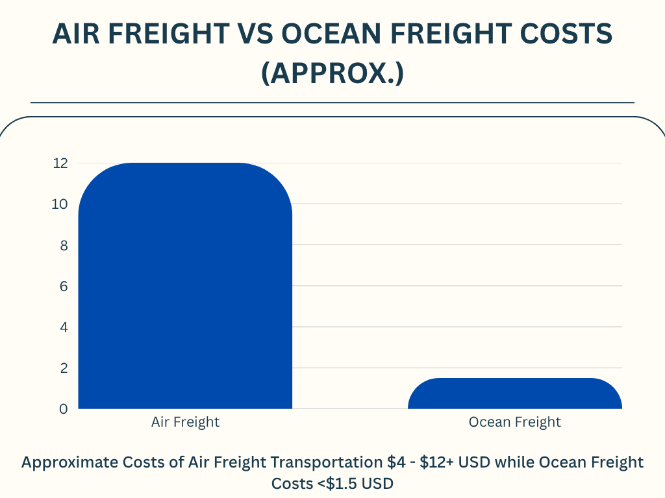
Figure 1: Cost comparison chart comparing approximate cost per tonne‑kilometre for ocean and air [3]
For bulk commodities such as oil, gas, coal, grains, ores, and many manufactured goods produced and consumed on different continents, only ships can bridge those distances efficiently at scale. Ports and sea lanes require a large upfront investment but subsequently allow continuous, high‑volume flows. By contrast, pipelines and rail are capital‑intensive and corridor‑bound, while air freight remains vastly more expensive and capacity‑constrained.
Key Middle Eastern maritime routes and chokepoints

Figure 2: Map showing the Strait of Hormuz, Suez Canal, Bab al-Mandeb, and the Turkish Bosphorus [4]
- Strait of Hormuz
The Strait of Hormuz lies between Iran and Oman and connects the Persian Gulf to the Gulf of Oman and the Arabian Sea. It is widely regarded as the world’s most important oil transit chokepoint because of the sheer volumes and limited alternatives. Through this narrow strait, an enormous volume of energy moves each day: on the order of 20 million barrels of oil can transit daily, together with major flows of liquefied natural gas (LNG) [5]. That translates into roughly one-fifth of total global oil consumption, more than a quarter of all seaborne oil trade, and about one-fifth of worldwide LNG trade in 2024 [6].
The cargo mix is dominated by crude oil and condensate, refined products, liquefied petroleum gas (LPG), and LNG destined mainly for Asian and, to a lesser extent, European and other markets.
On the export side, Saudi Arabia, Iraq, the United Arab Emirates (UAE), Kuwait, Iran, Qatar, and to a lesser extent Oman account collectively for more than 90% of crude and condensate volumes transiting the strait; Iraq and Kuwait are effectively dependent on Hormuz for oil exports, while Qatar is essentially dependent on it for LNG shipments [7].
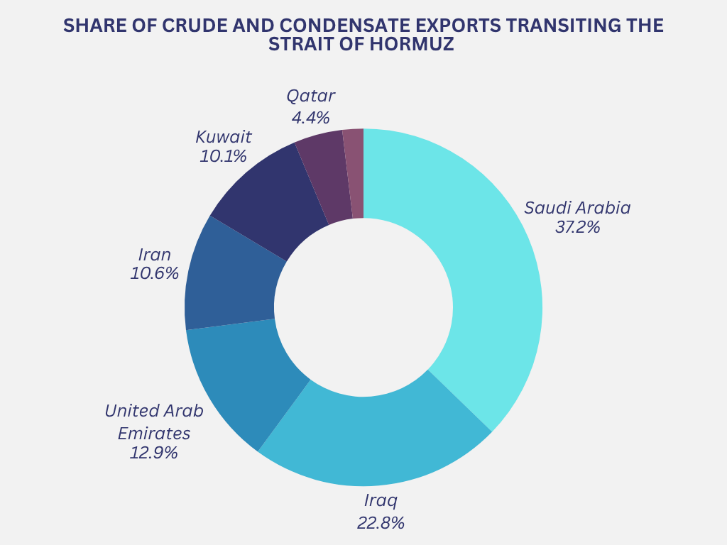
Figure 3: Share of Crude Condensate Exports Transiting the Strait of Hormuz [7]
On the import side, around 89% of crude and condensate flows through Hormuz head to Asian buyers, with China alone taking over a third of these volumes, followed by India, South Korea, and Japan.
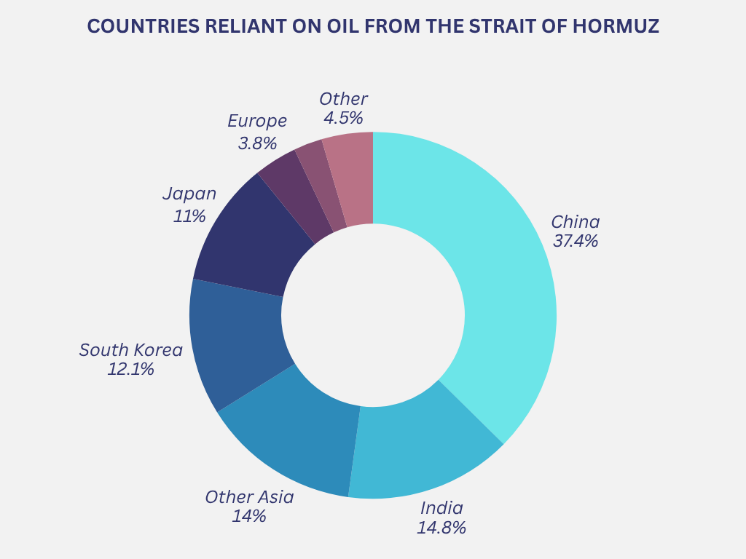
Figure 4: Countries Reliant on Oil from the Strait of Hormuz [7]
- Suez Canal and Red Sea–Bab al‑Mandeb corridor
The Suez Canal and Red Sea corridor connects Port Said on the Mediterranean to Suez on the Red Sea, with Bab al‑Mandeb at the southern exit into the Gulf of Aden and onward to the Indian Ocean. This route forms the shortest maritime link between Europe and Asia, allowing ships to move between the North Atlantic and the Indian Ocean without circling the Cape of Good Hope.
The canal is Egyptian sovereign territory, operated by the Suez Canal Authority and governed by a public, independent authority of juristic personality. It is the SCA, alone and exclusively, that issues and keeps in force the rules of navigation in the Canal and other rules and regulations that provide for a well and orderly run canal [8]. In the first half of 2025, about 4.9 million barrels per day of oil transited the Suez Canal, while roughly 4.2 million barrels per day passed through Bab al‑Mandeb; the corridor also carries a large share of Asia–Europe containerized trade and some LNG. European and Mediterranean importers rely on this system for Gulf and Asian oil, LNG, and manufactured imports, while Asian exporters, especially China, India, and ASEAN economies, use it for container exports to Europe [9]. Egypt, in turn, depends on toll revenues and the broader logistics ecosystem around Suez.

Figure 5: Map showing the sea route between Europe and Asia, allowing ships to move between the North Atlantic and the Indian Ocean through Bab El Mandeb and the Suez Canal. Source: EIA [10]
Recent Houthi attacks on commercial shipping in the Red Sea and around Bab al‑Mandeb have caused traffic through this corridor to plummet, with many vessels rerouting around the Cape of Good Hope, lengthening voyages by 10 days or more and sharply increasing costs.
Bab al Mandeb links the Red Sea to the Gulf of Aden and the Indian Ocean [11]. While it lies within the territorial waters of Yemen and Horn of Africa states, its role in global trade depends on high‑seas transit rights that keep this corridor open to international shipping.
An estimated 4.8 million barrels per day transit Bab al-Mandeb, roughly 5.5% of global oil consumption. For container shipping, the strait is the southern gateway of the Suez Canal route, which carries approximately 12-13% of global trade by value. Everything from European-manufactured goods to Asian electronics to agricultural commodities travels this route. In volume terms, this is approximately 19,000 vessels per year. For LNG, Qatari LNG destined for European markets must transit Bab al-Mandeb southbound before heading north through the Red Sea and Suez Canal. Qatar’s LNG exports to Europe, approximately 30 million tons per year, are entirely dependent on this route remaining open [12].
- Turkish Straits
The Turkish Straits system, the Bosporus and Dardanelles, connects Black Sea ports in Russia, Ukraine, and Georgia to the Aegean and Mediterranean via narrow channels running through Istanbul and Çanakkale. These straits handle around 3.5–3.6 million barrels per day of oil and petroleum products and large volumes of grain and metals [13], making them critical for Russian and Caspian exports to global markets.
For the Middle East, the importance is more indirect but still material: any prolonged disruption or militarization of the Turkish Straits reshapes commodity flows, freight rates, and geopolitical risk premia across the wider Mediterranean and European markets.
- Eastern Mediterranean–Levant routes
The Eastern Mediterranean–Levant routes link ports such as Haifa, Beirut, Lattakia, Port Said, and Piraeus into the broader Mediterranean network, carrying containers, refined products, offshore gas (from Egyptian fields and the Israeli Occupation), and general cargo. These routes are critical for the economies of the Israeli Occupation, Lebanon, Syria, and Egypt, supporting both trade and energy movements. In Egypt’s case, Levant routes also underpin LNG exports from the Nile Delta and provide key connections from regional markets to Europe and beyond.
How Dependent are Middle Eastern Economies on Sea Freight?
- Gulf oil and gas producers
Gulf producers—Saudi Arabia, the UAE, Qatar, Kuwait, Iraq, Oman, and Iran rely heavily on seaborne exports of hydrocarbons and seaborne imports of food, machinery, and consumer goods. For Iraq, Kuwait, and Qatar in particular, maritime routes are effectively the only large‑scale export channel; their fiscal and external positions are therefore tightly coupled to the security of Hormuz and connected sea lanes.
The UAE and Saudi Arabia have built large container and logistics hubs, Jebel Ali, Khalifa, Dammam, Jeddah [14], and position themselves as global gateways for transshipment and value‑added logistics. Oman, with ports such as Duqm and Sohar located on the Gulf of Oman and Arabian Sea, markets itself as a lower‑risk alternative outlet that bypasses the narrowest part of Hormuz.
- Transit and mixed economies
Egypt depends on maritime trade both as a transit hub, via the Suez Canal, and as an importer/exporter of food, fuel, and manufactured goods. Canal tolls, port activity, and associated logistics clusters are major sources of revenue and employment but also expose Egypt to traffic fluctuations whenever shipping lines divert around the Cape.
Iraq, on the other hand, has a short coastline in the Gulf and is extremely dependent on maritime exports, yet suffers from congestion, limited deep‑water capacity, and full reliance on Hormuz.
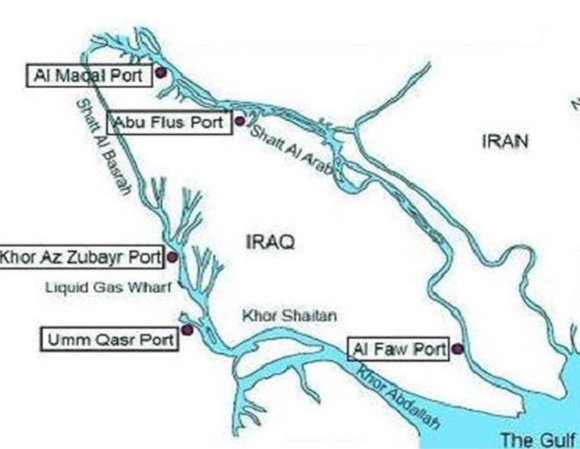
Figure 6: Map showing the major ports in Iraq. Source: SEANAV [15]
Furthermore, Iran, despite long coastlines on both the Gulf and the Gulf of Oman, has seen its maritime trade increasingly concentrated on a narrow set of partners, most notably China, due to sanctions and grey‑fleet arrangements. In contrast, countries like Turkey are relatively less dependent on maritime trade alone because they possess extensive land borders, rail and road links into Europe and Eurasia, and multiple energy pipelines from Russia, Azerbaijan, and Iraq.
Similarly, Jordan has a very narrow coastal outlet at Aqaba but significant overland links to Saudi Arabia, Iraq, and the Israeli Occupation, allowing partial substitution toward land routes when sea freight is disrupted. Lastly, Lebanon and the Israeli Occupation remain highly dependent on Eastern Mediterranean ports for trade, yet they are not structurally tied to a single energy chokepoint like Hormuz or Bab al‑Mandeb.
Route Reliance and Alternatives
- Saudi Arabia: Exports move from eastern Persian Gulf ports through Hormuz into the Arabian Sea, then toward Asia via the Strait of Malacca or toward Europe via Bab al‑Mandeb and the Suez Canal. The East–West Petroline connects eastern oil fields to Red Sea ports such as Yanbu, allowing several million barrels per day to bypass Hormuz and sail via Suez or the Cape, but more than half of the capacity remains “trapped” behind Hormuz in crisis scenarios.
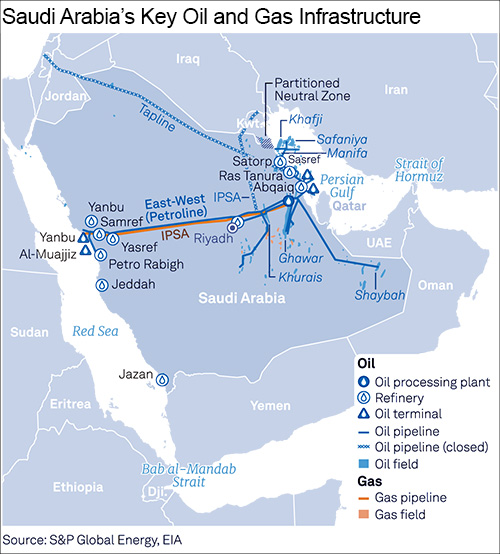
Figure 7: Map showing Saudi Arabia’s Key Oil and Gas Infrastructure [16]
- United Arab Emirates: The UAE’s main exports leave Abu Dhabi and Dubai through Gulf Sea lanes and Hormuz into Indian Ocean routes. The ADCOP pipeline from Habshan to Fujairah on the Gulf of Oman enables up to around 1.5–1.8 million barrels per day of crude to load outside Hormuz [17], yet a large share of exports, especially refined products and LNG, still depends on the strait.
- Qatar: LNG and condensate exports from Ras Laffan are almost entirely seaborne and pass through Hormuz, then either toward Asia or, via Bab al‑Mandeb and Suez, to Europe. There is no alternative deep‑water outlet at a comparable scale, leaving Qatar essentially 100% maritime‑ and Hormuz‑dependent for its core export.
- Kuwait and Iraq: Exports from Gulf ports are largely routed through Hormuz; pipelines to Turkey (Iraq–Ceyhan) and potentially Jordan provide some diversification, but these volumes are modest relative to total exports and exposed to their own political and security risks. Both economies are therefore highly vulnerable to any prolonged disruption of Hormuz.
- Iran: Iran exports primarily through southern ports such as Kharg Island and Bandar Abbas, again via Hormuz into the Indian Ocean, though some shipments from Gulf of Oman ports avoid the narrowest segment. Overland trade with neighbors and Chinese‑linked corridors mitigate sanctions impacts but do not approach maritime capacity, leaving Iran paradoxically both gatekeeper and heavy user of Hormuz.
- Oman: Ports such as Sohar and Duqm on the Gulf of Oman and Arabian Sea allow exports and imports to bypass the tightest part of Hormuz, giving Oman a natural resilience advantage. This geography underpins its pitch as a base for investments aimed at reducing pure Gulf/Hormuz exposure.
- Egypt: Egypt’s maritime backbone is the Suez Canal, supported by ports such as Port Said, Suez, and Ain Sokhna connecting the Mediterranean and Red Sea. The Sumed pipeline offers a partial crude bypass between the Red Sea and Mediterranean when canal traffic is constrained, but sustained rerouting around the Cape would still erode traffic and revenues.
- Israel, Lebanon, and Jordan: The Israeli Occupation depends on Mediterranean ports such as Haifa, Ashdod, and Ashkelon, and Eastern Mediterranean energy routes integrated into global shipping lanes. Lebanon relies heavily on Beirut and Tripoli for imports, with limited fallback beyond overland links via Syria, while Jordan uses Aqaba as its main Red Sea outlet and partially offsets maritime disruption through land routes to neighbors.
- Turkey: Turkey channels Black Sea trade through the Turkish Straits to the Mediterranean, while its Aegean and Mediterranean ports link to Europe and Suez‑bound routes. Extensive road and pipeline networks reduce maritime dependence for energy and some regional trade, but the country remains a critical transit state for Black Sea commodities and energy corridors.
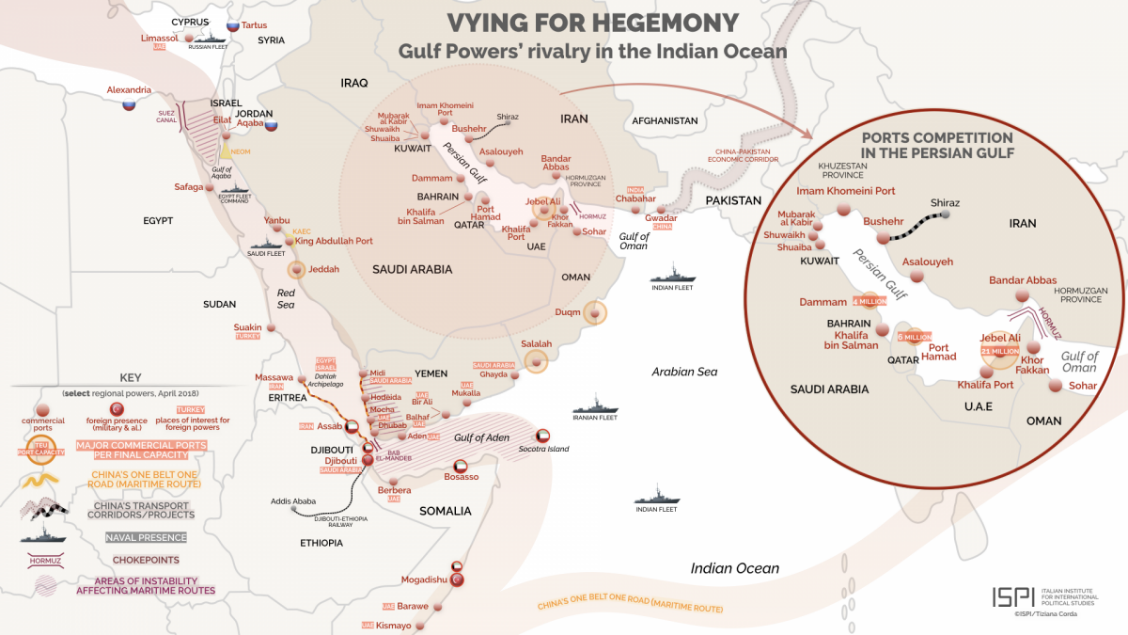
Figure 8: Map Showing major ports and sea routes in the Middle East [18]
Challenges, Vulnerabilities, and Emerging Opportunities
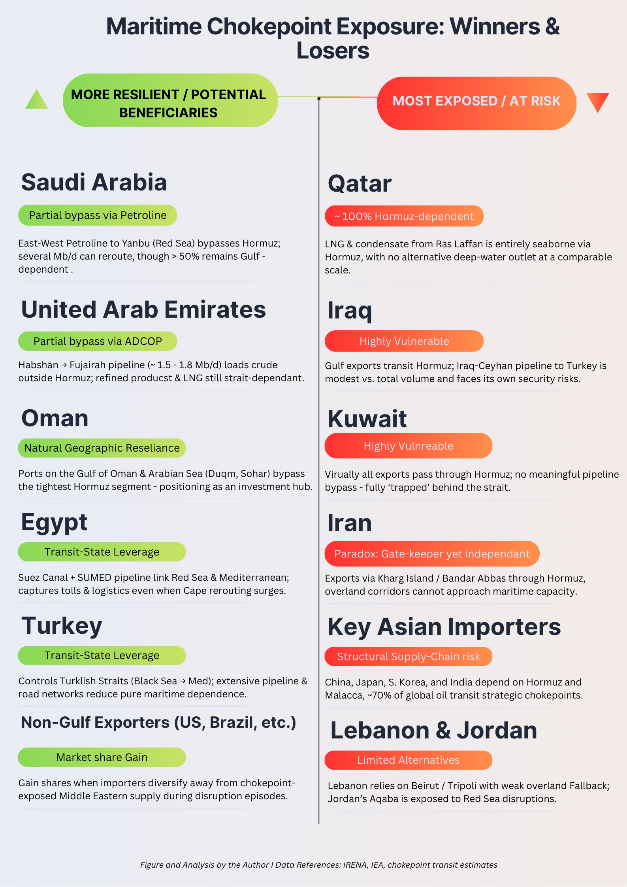
“Paradoxically, vulnerabilities are catalyzing investment and strategic shifts.”
This is reflected through the Expansion of Saudi Arabia’s Petroline and the UAE’s Fujairah‑bound pipelines, which can incrementally reduce Hormuz risk, while proposed oil and gas pipelines to Mediterranean or Red Sea ports (via Iraq–Turkey or Gulf–Red Sea corridors) could further diversify outlets over time, subject to cost and political feasibility. New and upgraded ports in Oman (Duqm, Sohar), on the Red Sea (Jeddah, King Abdullah Port, Port Sudan), and in the Eastern Mediterranean seek to capture traffic diverted from higher‑risk areas; Gulf hubs like Jebel Ali and Khalifa continue to position themselves as multipurpose transshipment and logistics centers.
Moreover, Eurasian land routes and proposed India–Middle East–Europe or Gulf–Levant corridors aim to shift part of high‑value, time‑sensitive trade to rail and road, or at least provide redundancy during acute maritime crises. While these cannot match maritime volumes, they can de‑risk supply chains and enhance options for shippers and states.
Lastly, the severity of recent disruptions is strengthening arguments for multinational maritime security arrangements in the Red Sea, Gulf of Aden, and Gulf region, involving Gulf states, Egypt, Turkey, and extra‑regional powers. From a strategic standpoint, Gulf states with partial bypass capacity (Saudi Arabia, UAE, Oman) can monetize their relative resilience and attract investment into pipelines and ports, while Egypt and Turkey can deepen their roles as indispensable transit states, capturing tolls and logistics activity alongside diplomatic leverage. Non‑Gulf energy exporters such as the United States, Brazil, Norway, and West African producers also benefit as importers diversify away from chokepoint‑exposed supply, gaining market share when Middle Eastern routes are under stress.
REFERENCES
[1] BreakBulk, ‘What’s Behind the Boom in the Middle East Port Development?’ 18 January 2020 https://middleeast.breakbulk.com/articles/whats-behind-the-boom-in-the-middle-east-port#:~:text=Despite%20the%20Middle%20East%20economies,volumes%20flowing%20through%20the%20region.
[2] UNCTAD,’ Review of Maritime Transport 2024’, https://unctad.org/publication/review-maritime-transport-2024
[3] Zarach Logistics, ‘Air Freight vs Ocean Freight Costs: What You Need to Know Before Booking’, 23 May 2025 https://zarachlogistics.com/air-freight-vs-ocean-freight-costs
[4] Port Economics Management, ‘Main Maritime Shipping Routes and Chokepoints’, n.d, https://porteconomicsmanagement.org/wp-content/uploads/Map-Passages-with-Shipping-Routes.pdf
[5] US Energy Information Administration, ‘The Strait of Hormuz is the world’s most important oil transit chokepoint’, November 21, 2023, https://www.eia.gov/todayinenergy/detail.php?id=61002#
[6] Statista, ‘Global Oil Shipments Depend on Major Chokepoints’ 18 June 2025 https://www.statista.com/chart/34642/world-maritime-chokepoints/
[7] Energy Now, ‘CHARTED: Oil Trade Through the Strait of Hormuz by Country – Visual Capitalist’, 04 March 2026 https://energynow.com/2026/03/charted-oil-trade-through-the-strait-of-hormuz-by-country-visual-capitalist/
[8] Suez Canal, ‘SCA Overview’, n.d, https://www.suezcanal.gov.eg/English/About/SuezCanalAuthority/Pages/SCAOverview.aspx
[9] AA, ‘Around 70% of global oil demand transported through strategic maritime chokepoints’, 11 March 2026 https://www.aa.com.tr/en/economy/around-70-of-global-oil-demand-transported-through-strategic-maritime-chokepoints/3857495#:~:text=In%20the%20first%20half%20of%202025%2C%20oil%20shipments%20averaged%204.9,the%20Bab%20al%2DMandeb%20Strait.
[10] EIA, ‘The Bab el-Mandeb Strait is a strategic route for oil and natural gas shipments’, 27 August 2019 https://www.eia.gov/todayinenergy/detail.php?id=41073
[11] MEPEI, ‘The Geopolitical Importance of Bab el-Mandeb Strait: A Strategic Gateway to Global Trade’ 28 February 2024 https://mepei.com/the-geopolitical-importance-of-bab-el-mandeb-strait-a-strategic-gateway-to-global-trade/
[12] The Middle East Insider, ‘Bab al-Mandeb: The Second Chokepoint That Could Shut Down Global Trade’, 29 March 2026 https://themiddleeastinsider.com/2026/03/29/bab-al-mandeb-strait-houthi-global-trade-2026/
[13] Marine Insight, ‘6 Bosphorus Strait Facts You Must Know ‘, 10 May 2022 https://www.marineinsight.com/6-bosphorus-strait-facts-you-must-know/
[14] MAERSK, ‘Make way for the Middle East: UAE, KSA’s ambitious drive to become global integrated logistics hubs’, 17 April 2024 https://www.maersk.com/insights/integrated-logistics/2024/04/17/make-way-for-the-middle-east
[15] SEANAV, ‘Major Ports in Iraq’, 25 February 2024 https://seanav.org/major-ports-in-iraq/
[16] Engineering News Record, ‘Hormuz Bypass Infrastructure Was Sized for a Short Disruption. This Is Not That.’ 13 March 2026, https://www.enr.com/articles/62677-hormuz-bypass-infrastructure-was-sized-for-a-short-disruption-this-is-not-that
[17] CNBC, ‘The two oil pipelines helping Saudi Arabia and UAE bypass the Strait of Hormuz’, 12 March 2026 https://www.cnbc.com/2026/03/12/strait-of-hormuz-oil-pipelines-iran-war-saudi-arabia-uae.html
[18] Italian Institute for International Political Studies, ‘Gulf Powers: Maritime Rivalry in the Western Indian Ocean’ 11 April 2018 https://www.ispionline.it/en/publication/gulf-powers-maritime-rivalry-western-indian-ocean-20212
